M2: Pet Sitters Australia (PSA) - Module 2 - Pet First Aid & Animal Behaviour Basics Training

| Resume a previously saved form
Resume Later

In order to be able to resume this form later, please enter your email and choose a password.

Password must contain the following:
  • 12 Characters
  • 1 Uppercase letter
  • 1 Lowercase letter
  • 1 Number
  • 1 Special character

Welcome to the Second Module!


You are about to begin the second module of you PSA Training and induction course.

This means that you have already been deemed competent in Module 1, so.......

Well done!


To recap the reasons for this course, PSA Pet First Aid training is provided to assist you in recognising and responding to an emergency (using basic life support measures), so that you have the ability to provide an initial response where pet first aid is required.

Learning to provide basic first aid for animals will enable you to have the ability to respond positively to emergencies in line with practised actions and demonstrate basic first aid casualty management principles.


At PSA we believe in investing time and effort into you our carers, to provide you with the skills to confidently manage most emergency situations with Basic First Aid training


Our Goal is to cover the following elements :

                The ability to Assess the situation (You have achieved this in Module 1!)

                Recognising an emergency (You have achieved this in Module 1!) 

We had also touched on some of these following areas during module one - and you should have already viewed the recommended "Video study list" - which was provided to you on completion of module 1 - and also sent to you as an email.

Once you have viewed these videos - you will have received valuable insight into practicle first aid methods. 

We will also be providing content to you Module 2 (and a further module) to cover the following:


                Identifying risk to yourself, bystanders and the pet/animal

                How to take action to minimize immediate risks to all

                Assess the physical condition and vital signs of the animal

                              To appropriately apply basic first aid and basic care

               The Pet/Animal is reassured in a calm & caring manner.

               The Pet/Animal is made comfortable using available resources

            (i.e. use items that are in the near vicinity so you can respond quickly!)

                Handle the pet/animal safely, gently and calmly (humanly) at all times

             to minimise pain, stress or further injuries to the animal/pet & yourself

                First Aid provided in accordance with established first aid procedures.

                First Aid assistance is sought from others as appropriate & required. 


 OH&S matters

As per module 1, at all times you should minimise risk to yourself, the pets and other bystanders by the use of basic Occupational Health & Safety (OHS) procedures & Personel Protective Equipment (PPE)

Keeping YOU safe when you respond to an emergency situation.


Training methods.

Resources: 

     The First Aid Basics Course online coursework (all here in this online format for your reference)

      PSA – Pet First Aid Basics: Assessment Questions (Found at the end of each session for submission when complete)

      Links (URLs) to good additional sites & Video content that adds additional assistance work is part of the session plan)


PSA – Pet First Aid Basics Course v1.6

Plus

PSA - Pet/Animal Behaviour Basics V1.0

Hello and Welcome Back to your next module of the Pet Sitters Australia (PSA) training course


Just recapping that the aim of this PET FIRST AID Basics course is designed specifically to provide principles for short term emergency treatment, prior to seeking professional Veterinary care.

It is designed to help an individual to provide emergency assistance, when attending to an animal when it is sick, injured or distressed.

The course covers the basics of: .

Safety awareness - for both the attending carer and the animal (OH&S)

Assessment of the animal issues using base line ‘normal’ to current status,

Principles of Stabilization and Care with the animal (Remain calm & gentle) 

Appropriate Methods and Manner of Transportation to a Vet 

This course is designed to equip the attending PSA Carer Entity or Pet Owner with a basic knowledge in pet first aid.

This course does NOT in any way equip any person who completes it, to be a Veterinary Carer or practitioner and in fact directs all persons to seek appropriate and professional Veterinary Practitioners Care, Assistance and Supervision at all times where practical

The Pet/Animal Behavioural Basics Training DOES NOT entitle any entity to become a Trainer/Practitioner as a behaviourist or to provide Pet/Animal Behavioural Assessment or support.

This component of the course is provided to enable PSA Carers to work with and introduce themselves and their pets/animals with practical behavioural management and the methodology of dealing with pets/animals.

It is for provided as a basis of practical knowledge and home & the management of pets/animals only.  


Mandatory Answer

Mandatory Answer

Online - PSA Pet First Aid Training Enrolment - Module Two


PSA hope that you are finding this course valuable.  We want to help our carers to have the ability and confidence to assist animals that are within their care, including their own pets and the pets of PSA Clients.

What you can expect from this course.

The courses PSA provides are practical  and we will help you as you work through the course similarly to module 1. 

You answer the questions as you progress through each module and if you have issues with any questions you may choose to respond again – or ask for more assistance regarding the course. 

Our goal at PSA is to help you to achieve this competency – so if you need help – we will be helping!

J

There will be several modules provided which build up to complete the entire course:

You are about to begin Module Two and this will be achieved by providing reading relevant the assessment area you will find at each section of the module!

It is important to note that if you see a red asterix (*) next to any question then it is MANDATORY for this to be answered before you can move onto the next section or question (if you forget to answer a question - you will have a feint red line surround the questions requiring an answer - once you do select an answer you can submit and continue on!)


Shall we start Module Two?


Mandatory Answer

Mandatory Answer

Mandatory Answer

Module Two (2) - Section One (1): Pet First Aid Introduction

This sections content will be outlined along with related assessment sections – please work through these and answer as you go along!

The Subjects to cover are;

Training and Assessment section 2: Handling an emergency.

Assessment - Checking your understanding & observation of the following scenarious and appropriate Pet First Aid actions:

Injury & Illness Common Signs & Pet First Aid Actions

Choking

Arrest (cardiac) & resuscitation (CPR - cardio pulmonary resuscitation)

 - Rescue Breathing

 - Chest Compressions

Seizures

Vomiting and Diarrhoea

Diabetic Emergency / Hypoglycaemia

Boat & Torsion

 - Gastric and Intestinal Foriegn Object

Wounds

 - Bleeding (Controlled Bleeding)

 - Bandaging Wounds

Shock

Burns  

 - Thermal Burns, Electrocution & Electrical Burns, Chemical Burns

Sprains & Strains

Fractures (Broken Bones)

 - Splinting

Birthing & Newborn care

Poisoning & the environment

 - Common Food & Drug Dangers (Attention - Hazards!)

 - Common Chemical Dangers

 - Common Dangers

 - Common Toxic Plants

 - What to do if a pet is poisoned

The environment (Harsh conditions - heat, cold etc), Motion sickness,

Bites:

 - Insect Bites (Bees, ticks etc)

 - Snake Bites


Assessment Questions for the above topics will be provided during the session.  All questions have mandatory answers, you can save your submission or go back to it over time if you select this option.  Just know we are here to help you if you need it!


Pet First Aid Course Module 2: 

During this course you will generally be asked to select a "Yes" or "No",  a "True" or "False" - or "Multiple Choice" as an answer

We recommend that for ALL multiple choice questions that you read and review all answers and then select the MOST correct answer!

Example Questions follows here:


For all multiple choice questions please review all answers and then select the MOST correct answer - In this example - you should select "F) All of the above" as this is the MOST correct answer!

(A) Know your Pet/Animal (Section 1)


Section 1: Taking Emergency Action 

When a pet is ill or injured, taking emergency action is the logical thing to do.


REMEMBER TO ALWAYS MAINTAIN YOUR OWN SAFETY FIRST (at all times including during the emergency too!)


The environment you are in can be dangerous so you MUST TAKE CARE AND PRECAUTIONS.


Injured or ill animals can be unpredictable – if they are in pain or feel threatened they may react negatively – you must always evaluate the situation carefully to insure your safety and the safety of others around you!


Take action appropriately – if an injured animal runs onto a busy road or highway, you must consider the danger for yourself as you respond to that situation. 

You must take into account the risks – “Is it safe?” is the question you should be asking yourself constantly – if your answer is “NO” you must call for help before you handle the situation alone.


IF YOU CAN PROCEED SAFELY – Provide this care now.  If you need to restrain the animal, do so with great care so as not to injure yourself or further injure the animal.


Your goal is to provide aid – but you must not do any further harm to the animal.


Although and injured or sick animal may appear calm and docile, they may not remain so when you are providing first aid care.


Restraining and muzzling:


Muzzling an injured animal is the best measure to protect you and other from being bitten – BUT


NEVER muzzle an animal that is coughing, vomiting or having difficulty breathing


Restraining a small or short muzzled dog or cat, in most instances may prove to be impossible. It is recommended that a blanket or a towel can be used to restrain smaller animals. Never block an animal’s ability to breathe with any cloth or object EVER!


To restrain a small dog or a cat, especially on who may me injured is the wrap a blanket or a towel snugly over the animal’s entire body.


Place your hands gently behind the animals head, wrapping the towel around the neck. It should NEVER be too restrictive or tight in a way that could cut of circulation or the ability to breathe EVER.

Use the towel to stabilize the head or the entire body if needed. Be sure to position you hands closely behind the head near the ears to prevent biting, the further away your hands are from the mouth of an animal, the LESS likely you are to be bitten.


If restraining a small dog without the use of a blanket or towel, try to feel for the lower jaw and hold firmly. Avoid grabbing or squeezing the neck of the animal if is thrashing about, or resisting.  You should NOT attempt to restrain it using only your hands, but should use a blanket or towel or larger piece of thick clothing for your protection.


REMEMBER TO ALWAYS Exercise caution and to use the minimal amount of restraint possible to contain the animal - particularly if it is having difficulty breathing.


Restraining a cat is different to restraining a dog. 

Cats can become even more upset during the process of restraining them.  Cats also have more potential weapons to lash out, including sharp teeth and claws.

A cat bite is second only to a human bite in severity in terms of potential bacterial and infection. (Yes human bites are far worse!)  EXTREME CAUTION must be used when attempting to restrain a cat. 

When using a towel it is best to ‘come over the top of the cat from behind and grab the front legs gently but firmly as well, keeping your hands behind the head and covering nearly the entire cat’s body.

If you can also cover the back legs, you can also protect yourself from getting scratched. 

Another option for restraining a car is called ‘scruffing’. 

This is the safest way of restraining a cat if you do not have a towel or blanket.

SCRUFFING: You grab the loose skin at the back of a cat’s neck firmly. DO NOT pull the skin so tight that you cut off the animals breathing, just firmly enough to gain control.  Place you hand close to the head and ears.

Placing your hand too far down would allow the animal to squirm and move around to scratch or bite. 

If the cat tries to use its back legs as a weapon, you can hold the back legs with the free hand.  Lay your arm across the cats back for more control and also to avoid injury.

The closer your hand is at the cats ears and head, the less likely you are to get bitten – this method is called the scruff and stretch technique.

(If lifting the animal by its scruff, you should also endeavor to support weight somewhat under its back legs gently, bringing your hand in from the base of the tail, sweeping the legs gently up in a scooping lift should help to support its weight)


Restraining medium and large dogs:

When restraining a large dog, you will need to use more than your hands.

It may be necessary to use your entire body, once again the closer your hands are the rear of the animals head near and behind its ears, the less likely it is you will be bitten. For a very large dog you will need to bend down close to the animal.

Place one arm under the animals head, securing the back of its head with your hand, do NOT squeeze the neck!

Place your second of arm over the animals back and up under the chest.

Maintain a firm hold, being careful not to apply pressure to any obvious injuries or wounds….

And if the animal flinches from a touch know that there is probably an underlying injury – be firm and gentle and be careful.


Muzzling

When you are attempting to muzzle an animal, the chances are you will also be restraining at the same time, you can pre-make a loop/knot as part of the muzzle first before attempting to place a muzzle over the animal.


1)      Use a long piece of rope, a torn strip of towel, sheet, blanket, or a t-shirt to improvise a muzzle. Do not use any material that will catch on itself as you could get the muzzle too tight and cut of circulation. (If you cannot improvise with a material safely - then trying to use something incorrect can cause injury to yourself and the animal by attempting a flawed method or wrong materials. If you judge it as impossible do perform without causing harm to anyone then best not to attempt it at all).


2)      To create a muzzle, get a lenght of the material you have selected and start with a loose half knot under the lower jaw. If using a premade knot, slip the loop over the animals mouth and tie the knot under the head

3)      Extend the ends above and behind the head, tying a square knot behind the ears.

4)      The muzzle needs to be fairly secure to keep the dog from removing it with its paw. You will most likely not be able to get the muzzle tied tightly enough to avoid the potential for being bitten. NOTE that a bite can still occur when an animal is muzzled so always exercise caution to protect yourself from injury at all times.


Carrying and transporting


When transporting an animal you must be careful not to cause further pain or injury.

Move the animals slowly and methodically (No jerking) and speak in a low, calm voice taking care not to frighten the animal.

Time is of the essence – you can use ‘found’ objects to create a makeshift stretcher using a board or other hard surface. Use towels or blankets for comfort.

Take precautions against possible injury to yourself from thrashing or biting – i.e. Don’t waste time looking for medical grade bandages or objects - Use any nearby suitable substitute items so you can attend to the animal quickly! (i.e. Clothes, towels and blankets can be substituted for bandages – time wasted can mean that a life is lost!)


Small Dogs:  Gently lift and cradle the animal in your arms with the injured side held softly against your body to provide stability. Place the animal in a box or carrier to transport it to a vet.

Medium or large dog: place one arm around the neck & the other arm behind the legs (unless inured) Place the animal on a solid surface to transport.

Cats: Use either the small dog technique or hold the cat by the scruff of the neck whilst supporting the body with your other hand, Place the care in a box or carrier to transport.


The most critical and important action is to get the sick or injured animal to the vet or other emergency animal facility as quickly as possible – with the least possible amount of stress or additional trauma to the patient – and by keeping yourself and others safe from injury!


Key points:

BE GENTLE, CALM AND KIND –Speak softly and calmly move purposefully and carefully.

DO NOT CAUSE DISTRESS OR FURTHER INJURY!

Do NOT waste time.  Fist Aid needs to be treated as emergency care


Calling for help! – Be prepared so that it is EASY to do!


Be prepared! During a medical crisis the last thing that you want to do is to try and find out where the vet or emergency clinic is located.


Be prepare by placing the vet emergency details and medical information where you can get to it quickly in an emergency (On the fridge for example)


Your list should include:

o   Your vets name, clinic name, address, phone number and business hours

o   Direction or map to the vets

o   Directions to the emergency clinic

o   Phone number of the poisons control centre (Australia)


A list of medications that your pet is taking (Over the counter and prescribed) plus details on dosage and how often it is given (Flea and tick medications should also be on this list!)


Questions for this section follow here:

Assess whether the following scenarios and select either ‘True’ or ‘False” for the following (safety and OHS question/statements):


Mandatory answer - If an animal has injuries on to its face, if it is having trouble breathing, if it is coughing or vomiting - then muzzling is could cause further injury or possible death to the animals and it must NOT be muzzled!

Mandatory answer - If an animal has no injuries to its face, if it is not having trouble breathing, it is not coughing or vomiting - then muzzling is something that may help you and others from being bitten.

Mandatory answer - Even a pet that knows you well can be unpredictable if they are in pain or shock.

Mandatory answer - Remember YOUR safety needs to come first.

Mandatory answer - Remember YOUR safety needs to come first, try to get assistance if you need it - people will often come to your aid to help if you can flag them down safely and ask for their help!

Mandatory answer - Remember YOUR safety needs to come first.

Mandatory answer - Pet First Aid seeks to always act in a manner that causes the least amount of stress to the animal and to be as careful as possible to ensure that the animal is dealt with humanly. That the animal is caused no further injury or harm whilst administering first aid.

Mandatory answer - The aim of First Aid is to provide calm and controlled assistance to the injured. By remaining calm, and by attending gently and efficently with an illness/injury you reduce the potential of further anxiety and pain.

Mandatory answer - First Aid is the ability to assist in an emergency situation. Stabilising the patient is important so that you are able to transport the pet to a professional safely and swiftly when a need arises - speedy vet attention is a very high priority in Pet First Aid practices!

Mandatory answer - First Aid is the ability to assist in an emergency situation. Creating an unsafe situation by speeding or breaking other laws, or causing further pain or injury to the animal is absolutely NOT OK!

Mandatory answer -Again - The sound of your voice can help to calm and animal if you are using a reassuring calm voice - if you shout or move too fast - you can have a very bad reaction in your patient who may panic and hurt you or themselves due to this! Stay calm!

Mandatory answer -A piece of cardboard, an old door, a large stiff piece of carpet etc can all help to act as a temporary stretcher. Whatever you can find quickly and safely, any nearby useful object - USE IT - do not lose precious seconds trying to find a medical grade product - when time is crucial - it is more important to get the patient to a vet URGENTLY!

Mandatory answer - Try NOT to waste time trying to find a sterile bandage or other medical grade item/object when the patients time would be better spent getting to the vet urgently!

Mandatory answer - Common place items can really help you to make the animal more comfortable and to help them be more stable as well.

Mandatory answer - YOUR safety must be your priority. If you become injured you may no longer be able to help yourself or others!

Mandatory answer - If an animal is having trouble breathing or has blood, mucus or vomit in it's nose &/or mouth - a muzzle can cause a restriction that could prevent the animal from breathing - you DO NOT want to compromise the pet's life!

Mandatory answer - Gentle support of an injured animal is a great option.

Mandatory answer - Gently and carefully lifting the dog (or large mammal) onto a stable surface for transport & making them secure in a gentle yet safe fashion is a great option.

Mandatory answer - By gently and carefully lifting the cat and placing in a stable environment like a carrier or a box is highly recommended. We also suggest that you cover the carrier of the cat (or other small mammals & birds too) to help them to relax more - as a darker enclosed environment can feel 'safer' to a pet in distress. Whilst transporting them to a vet make them secure in a gentle & safe fashion is a great option.

Mandatory answer - As per the previous answer - Gently and carefully lifting the cat and placing in a stable environment like a carrier or a box is highly recommended. We also suggest that you cover the carrier of the cat (or other small mammals & birds too) to help them to relax more - as a darker enclosed environment can feel 'safer' to a pet in distress. Whilst transporting them to a vet make them secure in a gentle & safe fashion is a great option.

Mandatory answer - Pet First Aid only helps us to asses and stabilise a sick or injured animal whilst expediently getting them to a vet. It is crucial that a qualified vet provide medical assessment and care as soon as possible!

Section 3) Handling an Emergency - Types


Emergencies take many forms.  There are standard procedures to use based on the emergency with which you are presented.

Following are various scenarios with the appropriate course of action.  You may need to bring various techniques into one emergency so continue to assess and react according to your observations – First Aid is practical care.


Choking

Causes and signs of choking:.  Choking can be caused by objects stuck in the throat, such as food, toys, balls, and other foreign objects.

Trauma to the neck, throat, tongue swelling, or other facial injuries can also cause your pet to choke. An ill or injured pet especially one who has ingested something toxic or poisonous can also choke on his or her own vomit, if you can visibly see an object stuck in the animals throat and the animal is not breathing or as respiratory arrest, you may attempt to remove it by using utensils such as cooking tongs, or forceps. Form an occupational health and safety stanpoint we recommend that you never attempt to remove it with your finger or hands as you may be severely bitten.

Remember that your own safety determines you ongoing ability to assist your pet in an emergency.

Cats and Furballs.  Cats do not 'cough up' furballs – they vomit a furball as the fur that they ingest during grooming accumulates in their stomach and as it is a source of irritation it is most frequently vomited.  (TIP - If you groom your cats – there is less chance of this furball forming and for a possible bowel blockage)


Signs of choking are:

  •         A loud noise of cough when the animal tries t breathe out
  •         A rasping noise when the animal tries to breathe in
  •         Gagging or retching as if trying to vomit “Dry Heaving”
  •         Rapid Shallow breathing


Arrest and Resuscitation


In an emergency situation, breathing and pulse, the normal signs of life, may not be present.

To be prepared to provide first aid for your pet during an emergency, you must understand the difference between respiratory arrest and cardiac arrest.

In medical terms, respiratory arrest occurs when there is no longer the ability to breathe. Although breathing has stopped, the animal still has a pulse.

Cardiac arrest occurs when the contractions of the heart cease, leading to lack of oxygen in the blood, loss of heartbeat and eventually death in animals in respiratory arrest.

In humans, the primary cause of death is cardiac arrest.

Rescue Breathing is the emergency procedure to deliver air to a human or animal that is not breathing but still has a pulse.

This technique is frequently used in water related emergencies.

Resuscitation is an emergency first aid procedure performed when both breathing and pulse cannot be detected. 

The term CPR (cardiopulmonary resuscitation) describes the technique used to revive humans and animals then they are unconscious or appear to be dead.

The CPR technique is designed to replace the functions of the heart and lungs together. Although these emergency lives saving technique can revive the heart and lung functions, it is crucial to also return the brain to normal functioning. 

The technique known as CPCR (cardiopulmonary cerebral resuscitation also known as CPR) is designed to restore normal heart, lungs, and brain function.

The most important role of a first aid provider is the concentrate on rescue breathing and chest compression techniques while the animal is being transported to a vet clinic/facility. 

These techniques of basic CPCR are described in this course. You have also been provided with a visual reference source for these techniques in your video listings previously provided - it is crucial that you reference both methods to get a full understanding of the best methods to be used in any emergency situation.  What you see and hear done, along with reading materials and an assesment will help you to truly gain skills that you can use in a real world scenario.


If you experience an emergency situation with your pet or other animal requirs emergency life support, quick and appropriate action us crucial.

Take the necessary steps to save your pet’s life, and use caution at all times to keep yourself safe.

Transport your pet or other animal to your vet as soon as he/she is stable for follow-up and further emergency treatment.

NOTE! CPCR should ONLY be attempted when the signs of death (arrest) are clearly present - these signs are:

  •         There is total unconsciousness
  •         Breathing has stopped completely
  •         There is no heartbeat or pulse

CAUTION: Performing CPPR on an animal who does not meet all of the above criteria could result in serious injury to both the animal and the first aid provider.


A review of previous Video Course material provided is recommended - the following will help you with your assessment which follows:

CAT & DOG CPR:


Lay the animal on it’s right side (this keeps the heart at the top towards the First Aider and works best, 15 chest compressions, one abdominal squeeze to return blood to the heart and one breathe to provide oxygen to the lungs for the next set of chest compression – repeat process.


Cat CPR:
CPR- is an emergency procedure used to exchange air in the unconscious cat. This video shows you how. For more information you can also visit:


How to perform CPR on a cat


If your cat is not breathing by itself and is unresponsive, you can use an artificial breathing to try to restart the breathing process. First, you have to find out what technique to use in the unconscious cat.

Follow this QA:


Is your cat breathing? Try to see if the chest is moving up-down and you can feel the air out of its nose/mouth against the back of your hand or your cheek.


If YES, take cat’s tongue and pull it all the way out to free the passage. Watch for reaction from the cat.
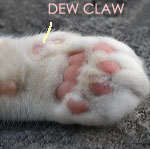


         cats dew claw pad location


If NO, check cat’s pulse. Does it have the pulse? The easiest place to find the pulse is right under the Dew Claw pad (see the picture) on the wrist equivalent area (under paw). Works both on the front or the back foot. Also, watch video below to see alternative areas, if you have trouble finding the pulse under the paws.


IMPORTANT: If your kitty has a pulse, perform Artificial breathing. If not, use artificial breathing with cardiac heart massage.


How to perform Mouth-To-Nose Breathing on a cat:


  • put a cat on a flat surface with its left side up, so its heart is up and not stressed by weight.
  • Clean any secretions (or any foreign things) out of its mouth. If it’s difficult to reach, perform the Heimlich maneuver.
  • Pull the cat’s tongue out slightly and, while its mouth closed, blow softly into kitty’s nostrils. You will see the chest rise up, so let it come back naturally down. Normally, any extra air you will blow will come out through the cat’s mouth. It’s perfectly fine.
  • If for some reason the chest doesn’t rise and fall when you breath in-out, use breath more forcefully and lightly seal the cat’s mouth with your hand.
  • Continue breathing like this once every 5 seconds until the cat regains breathing on its own, or until the heart beats.


Rescue Breathing

Remember - CPCR should ONLY be attempted when the signs of death (arrest) are clearly present:

You MUST determine that the animal is truly unconscious and not breathing.

Gently touch them and speak to them to see if they will respond. You could be SERIOUSLY injured if you attempt rescue breathing and the animal suddenly awakens

Always follow these steps before you begin rescue breathing in and unconscious animal:

1)      Extend the head and neck and pull the tongue forward to open the airway (OPEN)

2)       Remove any debris from the animals mouth (CLEAR)

3)      Look at the chest to see if there is any rise and fall motion (OBSERVE)

4)      Listen closely for any breath sounds for 10 seconds (Listen and Observe)

5)      If they are not breathing, begin rescue breathing (START IF JUDGED THIS IS NEEDED)

The ABC’s of Rescue Breathing: 

  •          Open the airway (straighten/outstretch the neck) and clear the mouth of any debris:
  •         Close the mouth - partially so that you can blow air into the muzzle/mouth/nose
  •         Then, use one hand to close the lips to ensure no air escapes while you are breathing in
  •         Using your other hand, feel the windpipe and locate the “Adams apple”.
  •        Position your hand over it so your fingers are on one side and the palm of your hand is on the other side
  •         Gently apply pressure to both sides of the windpipe to prevent breathing into your pets stomach instead of his/her
  •     Continue at a rate of 15-20 breaths per minute (until pulse and breathing become present & continue)


BE AWARE OF AND AVOID THE FOLLOWING COMMON MISTAKES OF RESCUE BREATHING:

  •         Breathing too fast (you must allow intake and breathing out of the pet – or you will overinflate the lungs)
  •        Breathing too hard (Which can damage the animals lungs)
  •        Breathing air into the stomach instead of the lungs (Chest rising with breaths – NOT the stomach!)


Chest Compressions


You can provide artificial circulation to your pet or other animal by giving chest compressions. In performing this kind of emergency life support, your goal is to provide enough blood flow to the brain and the heart to restore sufficient function. 

You should understand, however, that these chest compression procedures alone will not provide the normal blood flow to the brain.

If you are alone and find that you must perform chest compression, you should do so in combination with rescue breathing. 

Provide two consecutive breaths followed by fifteen consecutive chest compressions, and then repeat the procedure.

If you are able to enlist the assistance of a second person, one of you can focus on providing rescue breathing (Providing 15-20 breaths per minute) while the second person provides chest compressions at a rate of 100 compressions per minute at the same time

When performing chest compressions in a cat or a very small dog, your will actually compress the animals heart. 

The animal should be positioned on their RIGHT side (down) – left side up.

Place one hand up and under the chest and your other hand over the animals back.  Position your hands so that the fingers and thumbs of your hands meet

Be careful not to compress too hard and be sure to relax as well as compress.  Do not poke down: use a steady, even motion allowing the chest wall to come up between compressions.

Lay the animal on his/her side. Position the animals back up against your body where the chest makes a ‘v. In performing chest compression, you are actually generating pressure within the chest which helps move blood flow during an arrest.

The key is to get at the highest part of the chest because it is impossible to push the heart of a large animal. You will literally push down on the side of the animal’s chest.

There are several different options for positioning your hands:

1)      Place one hand on top of the other with fingers clasped together

2)      Place both hands flat with your fingers extended, one hand over the top of the other.

3)      Make a fist with one hand, placing the other over the fist.

4)     Do not punch at the animal when giving chest compressions, instead, push down firmly and evenly. Be careful not to use too much force as if you do use too much force you could break the animals ribs.

REMEMBER - the smaller the creature - the less pressure you should use!

You are trying to compress the heart to help it to pump blood around, if you have a larger animal you use more pressure - the smaller the animal the less pressure you should use. An Adult German shephard and a 6 week old german shephard puppy are a good example of different techniques and pressure should be used.  The pressure needed on the adult would SEVERLY injure the puppy.

Injury and illness - Common signs:


As a pet owner or carer, you know how a healthy pet looks, acts, smells and feels. Changes in behaviour, the way the pets body appears and even his/her smell can be early indicators of illness.

Do not ignore your own instincts of you suspect something is wrong.


Be prepared to seek assistance from your veterinarian if any of the following changes occur:


·        Irregular breathing, shortness of breath, prolonged panting

·        Unusual coughing, sneezing, gagging or vomiting

·        Swelling, redness, irritation or discharge from the eyes

·        Discharge, crusting, running or bleeding of the nose

·        Scratching, twitching, shaking of ears

·        Discharge or odour from ears

·        Change in colour, amount or frequency of urination

·        Change in eating or drinking habits

·        Change in body weight

·        Hair loss (* Not normal seasonal ‘Shedding’ of old coat), changes in colour of coat or skin

·        Peculiar odours from mouth, skin ears


Seizures


Seizures occur when the brain waves become abnormal.

During a seizure, and animal may experience uncontrollable and sometimes severe shaking. The animal may become unconscious or exhibit a lack of alertness/awareness. The animals mouth may be open or closed, and he/she may experience involuntary vomiting or flow of saliv

a.  Many animals are also likely to urinate or defecate during a seizure.  Most seizures last only a few seconds, but they can last longer.  A seizure last more than a minute can be very dangerous to your pet.

A seizure and a fainting episode may look very similar, but they are NOT the same thing!

Dogs and cats can both experience seizures and fainting episodes. While shaking of the body is common during seizures, and animal experiencing a fainting episode usually does not shake.

If fainting, he/she typically goes from normal behaviour to collapse and loss of awareness, and then back to normal immediately after the episode.

Following a seizure, the animal may seem confused or disoriented for a brief period of time.

If your pet experiences a seizure, you should take precautions to protect both of you. 

Remove any furniture or objects near the animal to prevent injury. Protect the head by using a pillow, blanket, towel or article of clothing, use this as a buffer if there are hard objects where teh pet may hit & hurt themselves.

Keep your hands away from the animals mouth; a convulsing animal may have involentary jaw movement and may unknowingly bite you. 

DO NOT attempt to reach into the animal’s mouth during a seizure as serious injury could occur - Keep any unprotected hands AWAY from the mouth. 

Also, do not try to hold his / her tongue.  Contrary to popular belief, dogs and cats do not swallow their tongue.

Attempt to time the length of theseizure as this information will be very important to your vet.   

POINTS TO REMEMBER:

  •         Contact a vet and get there ASAP
  •         NEVER reach into the mouth of an animal during a seizure
  •         Wipe away saliva or foam using a towel or blanket to allow the animal to breathe
  •       Use a towel , pillow, or blanket to buffer the animal from injury
  •       Never tie the animals legs together as this can cause them a very serious injury
  •       Protect the animal from stairways, furniture and other hazards that could cause further injury
  •      Use a blanket or towel to help steady the animal after the seizure, but never restrain it
  •      Be prepared to offer first aid if necessary


Vomiting and Diarrhoea

Vomiting may be caused by a variety of factors, including change in diet overeating, poisoning, disease, parasitic infections, car and motion sickness and food allergy.

Although vomiting is not uncommon in cats and dogs & other pets, it may indicate a serious problem and should not be taken lightly, particularly if other symptoms are present.  Other factors to consider include:

  •         Repeated vomiting over a short period of time
  •         Vomiting accompanied by dizziness or seizures
  •         Higher than normal body temperature
  •         Diarrhoea along with the vomiting
  •         Presence of blood in the vomit

Diarrhoea may also be caused by a large number of factors. Like vomiting, it may have resulted from the ingestion of something inappropriate or may be caused by parasites or other factors ad could indicate a serious problem.

The presence of blood in the bowel movement warrants the immediate attention of a vet. 

The presence of black (Charcoal black) bowel movements indicates bleeding from the stomach or small intestine and also warrants immediate attention by a vet.

Black bowl movements can occur in dogs and cats under medications (non-steroidal anti-inflammatory drugs – which should only be prescribed by a vet – so consult with them about the dark stools to ensure that these are normal if the animal is taking these)

Animals experiencing vomiting and/or diarrhoea may become dehydrated. Do not feed your pet until you consult your veterinarian.

Never give your pet any medication of any kind without the specific advice of a vet

Remember human drugs are NEVER suitable for pets – they CAN KILL THEM!

Only a VET is qualified to prescribe or provide animal grade drugs)


Milk:  do dogs and cats need milk?  Kittens and puppies receive their mother’s milk – they have no need for other milk products which can cause harm - as many animals have lactose intolerance or may have a reaction to other elements found in cow milk. 

This can actually lead to irritation of the digestive system and lead to diarrhoea.  If an animal is needs a milk product there are some Pet milk products they may be used as they have had most of the irritants removed from the formulation:

IMPORTANT NOTE:
If you have rescued baby animals DO NOT provide them with cows milk as most animals are unable to digest the lactose. It is better to hydrate them with standard Hydralyte solution (unlfavoured - make up the total amount and discard what cannot be used immediately) you can also add a teaspoon of honey to the total amount of the hydrolyte solution - this glucose and salts mix is a short term First Aid hydration ONLY. You should use a droper and not overload the animal with volume of fluids as this could make the animal choke or inhale the formula - which can be lethal.  IMPORTANT - The native animal MUST be brought to a vet &/or a wildlife carer for EXPERT advise and care! (Please note that Native animal babies need the care of those who have done extensive specialist training in this arena!)

Until you can get this native animal to the vet/expert carer - keep them warm and keep them in a quiet, dark well ventilated area away from the interference of other pets and children as too much attention, noise or commotion is very stressful for any animal and can lead them into a state of shock which in iteself can be life threatening.


Diabetic Emergency/Hypoglycaemia

Dogs and cats can become diabetic just as humans do. 

Diabetes is actually quite common in both these animals.  If your pet has been diagnosed with diabetes, you should keep high sugar content syrup on hand.  If your diabetic pet requires medication, keep an extra supply in your first aid kit.

Signs of a diabetic emergency (Low blood sugar) include depression, collapse or inability to move and seizures. 

If a pet shows signs of low blood sugar, place a small amount of syrup on the gums and take him/her immediately to your veterinarian.


Bloat and Torsion

Bloat and torsion indicate an abnormality of the stomach causing it to enlarge. 

Bloat indicates that the stomach is larger than normal, but remains in its normal position.


Torsion also indicates that the stomach is swollen; but has twisted or turned on itself, indicating a much more serious or potentially fatal situation. 

Only and X-ray can determine whether the animal has bloat or torsion. Both of these conditions are SERIOUS and MUST be treated by a veterinarian.


Bloat occurs in any size dog (& other animals including humans!) and is most commonly associated with overeating (or eating too fast).

Dogs that eat an entire bag of dog food can develop what is often called food bloat. Treatment by a vet is required for a food bloat to resolve. Occasionally bloat can lead to torsion, which is a much more serious problem that requires immediate care.

Torsion is a life threatening distention of the stomach that most often occurs in large dogs. The dog’s stomach becomes filled with air, food and fluid that cannot be expelled.  If this is not corrected within a few hours the pet may die.

If the pet keeps getting up and moving around like he’s uncomfortable, retches but is unable to vomit, looks extremely bloated, is depressed or is salivating a lot, go to your vet for immediate care. 

These symptoms may be an indication of torsion of the stomach. An x-ray will allow the vet to make and accurate diagnosis.

Surgery is the only corrective treatment for torsion.  Blood flow to the stomach and spleen stop during torsion causing the dogs to go into shock. Since the stomach cannot return to its normal position immediate surgery is required. Without surgery the torsion of the stomach will lead to tissue death and infections and complications leading to death.

The enlarged stomach is usually the first symptom of either ailment.  The animal may attempt to vomit unsuccessfully.  Heart and pulse rates will typically be slightly higher or higher than normal.  The animal may appear restless, unwilling to lie down or reluctant to allow you to touch him/her. Do not give ANY medication – including antacids.  Do NOT put pressure on the abdomen.

Keep the mouth and nose clear of any debris, including foam, saliva, or vomit, exercising caution and not to frighten the animals.

(KEY POINT: Transport the animal immediately to your veterinarian.)


Gastric and Intestinal Foreign Object

Gastric and intestinal foreign bodies are objects animals may have eaten which remain stuck in their stomachs or intestines.

Prevention is the best course of action. Make sure your pet’s chew toys are safe and do not have small parts which can be pulled off and eaten.  Do not expose your pet to things he/she may be tempted to eat and keep all garbage well contained & covered.

Foreign bodies can include coins, string, ribbons, children’s toys, food wrappers, and just about anything your pet can find a garbage can!

If you know that you pet has ingested a foreign object, DO NOT attempt to induce vomiting. 


The foreign object can get stuck in the esophagus (organ between the mouth and stomach) which is much more serious problem. 

Do not give your pet any medication. 

If a string is hanging from the mouth or from the rectum, do not pull on it as potential serious damage can occur. (it may be attached to something else which may perforate an organ if you try to pull it out!)

Some foreign objects may have components to them that could become toxic if they break down in the gut. 

All objects should be assessed at the vets with all available known information made available to the vet to help in this assessment.

Some foreign objects can be removed using an endoscope and don’t involve surgery.  However these objects will need to be removed surgically if it cannot be removed this way - or naturally through defecation.  Any dog or cat or other pet that has a foreign object in the stomach or small intestine that is vomiting, has diarrhoea and/or is not eating will likely require surgery

Wounds

Wounds to your pet may take the form of abrasions, cuts and lacerations, bruises (contusions), punctures, and impaled objects. Any serious wound (if blood is gushing, the bleeding cannot be controlled, or if the animal is in shock) should be treated by a veterinarian immediately.

(Animals cannot heal all of their wounds by licking them. They can actually cause further damage to their own wounds by licking them excessively)

Controlled Bleeding

Bleeding can be the result of any type of wound or injury.

Bleeding can be external and thus normally visible, or bleeding can be internal (inside the body).

Loss of blood may lead to shock or even death, so controlling bleeding is a necessity. Proper animal restraint is critical to both, your safety and the safety of your pet.

An injured animal can be very unpredictable, particularly if they are in pain. You should assume that the animal is experiencing pain and act with due caution. 

In most cases of external bleeding, direct pressure applied to the wound will control the bleeding, Wearing disposable gloves is advised when treating a bleeding animal. The blood may be coming from a vein, artery, muscle or bone. 

If the blood is pulsating and bright red in colour, the bleeding is coming from an artery. Blood flowing from veins, muscles, and bones does not pulsate.

To control bleeding, apply direct pressure to the wound while transporting the animal to a veterinarian.  Never apply a tourniquet to control bleeding as the risk of further injury is far too great.

Bandages made from clean, soft, absorbent material can be used, but direct pressure using any available material (i.e. clothing, t-shirts etc) is still preferable to a bandage if you do not have one on hand.

If using a bandage, you can secure it with tape, but do not use rope of string as this may tie it off too tight - this can cause a loss of circulation and can lead to tissue damage. 

ALWAYS use extreme car when handling the animal to avoid causing further stress.

Note: Tourniquets should not be applied to control bleeding.  More damage could be caused by using them.  Applying pressure to a wound should be used instead.

Bandaging Wounds

If you are bandaging a wound in the event of an emergency before transporting to the vet, it is far more critical to cover the wound with a clean material that you have on hand rather than waste time trying to find proper dressings.  Time is of the essence.  Applying pressure to control bleeding and seeking immediate medical vet assistance is the best course of action!

Shock

Shock is a life threatening condition, which occurs as a result of a serious illness.  It can result in collapse and lead to death.

Shock occurs when there is a collapse of the circulatory system (heart, blood vessels and blood) due to blood loss, fluid loss, low blood pressure or heart failure.

Blood loss occurs when there is either external or internal bleeding. Although there may be no obvious sign that bleeding has occurred, the volume of blood in the vessels becomes insufficient for the body’s needs, resulting in shock. 

Fluid loss occurs through vomiting or diarrhoea which results in dehydration, loss of blood volume and often leads to shock. 

Decreased blood pressure may be the result of infection, poisoning, pain or heart failure

Signs of shock include:

  •         Pale or white gums
  •         Rapid heart rate
  •         Rapid or weak pulse
  •         Rapid or weak breathing
  •         Lethargy, drowsiness, or loss of consciousness

How to handle Shock

  •         Stop any visible signs of bleeding
  •         If the pet is unconscious, place him/ her on his/her side and extend his/her head forward
  •         If the pet is conscious, allow him/her to make themselves comfortable
  •         Do NOT give your pet food or water


Thermal Burns


There are many kinds of thermal burns - Thermal burns are caused by excessive heat & sometimes Excessive Cold (Dry Ice burns)

  •         Hot liquids
  •         Fire and flames
  •         Scalding water and other liquids
  •         Hair dryers
  •         Hot metal
  •         Heat lamps
  •         Room heaters ad radiators
  •         Hot stove tops
  •         Sunburn in dogs and cats with white fur colour, little or no fur coat and pink (non pigmented skin)

If you actually see the burn occur, you will be better able to describe it to the vet. 

If you do not see the burn occur, assess the area where the pet was located to try to determine the cause. 

Your vet will need as much information as possible, including the source of the burn and how long ago it occurred

If you are dealing with a heat related burn, flush or immerse the burned area with cool cold  water (not near freezing as this can cause other problems!).

The cold water will draw the heat from the burn, preventing further damage to deeper tissues. 

DO NOT apply butter grease or ointments to the burned area. Cover the burn with a clean moist cloth and transport the animal immediately to your vet.


Electrocution and Electrical Burns

Electrical contact can cause the most serious types of burns and can cause respiratory failure and death.

There is frequently a burn across the middle of the tongue and lips, particularly with puppies and kittens as they tend to chew and bite everything. 

If the skin is burned, the burned area may not show damage to the superficial skin although severe damage may have occurred deep within the burned area. 

In contrast, you may see severe signs of an electrical burn including seared flesh, reddened skin or blisters.

The animal may suffer respiratory distress, rigid limbs, a glassy stare, and may collapse and go into shock. In severe cases, the animal may already be unconscious when you find him/her.

If you know or suspect your animal has suffered an electrical burn, TAKE CARE - take immediate steps to remove yourself and the animals from any danger. 

Be careful of any live electrical wires and turn off the electrical power source if possible before touching the animal.

An animal that has suffered an electrical shock or electrical burn should be covered with a blanket or coat (to help maintain body tempurature to reduce the potential clinical shock) and taken to a veterinarian immediately for medical treatment.


Chemical Burns

Chemical burns are not as common as thermal burns.  The typical chemical burn is due to a pet investigating or licking some type of corrosive chemical. 

The burn is often due to a pet ingesting or licking some type of corrosive chemical such as a bleach or disinfectant.

Chemical burns are often on the surface of the tongue and may affect the esophagus.

If the pet has been exposed to a chemical, he/she may have a swollen tongue, have difficulty swallowing, drool or paw at his / her mouth, and may show no interest in eating or drinking.

A chemical burn in the area of the mouth will often result in a whitening of the surface of the tongue (but not always).

Chemical burns to the skin should be rinsed with large amounts of fresh water to remove the chemical.

Take precautions to protect yourself from the contaminant by wearing rubber gloves where possible.

Cover the burned area with non-stick gauze dressings if you have any, to prevent your pet from licking the burned skin and further injury.

ALWAYS seek the advice of your vet in the event of a chemical burn.

Drooling dogs:  Dogs may drool as a sign of anticipation of food, or affection, or the animal may have men exposed to a toxin. Keep an eye on them and check the signs and symptoms described in this text!


Sprains and Strains

Sprains and strains are injuries to the soft and connective tissues of the body, and typically occur in the joints of an animal’s limbs. 

Sprains are injuries to ligaments, tendons and other connective tissues and are usually fooled quickly by rapid swelling in the joint. 

Strains are injuries to muscles or hr locations where the muscles become tendons.  An animal that has suffered a sprain or a strain will usually not walk normally or may refuse to walk at all.

Treat sprains by applying a cold compress o the swollen area, Wrap the area gently but firmly with a clot or gauze bandage.

Try to keep the pet quite and discourage activities which may affect the injured area. Consult a veterinarian for treatment.

WARNING!!!!

Do NOT give a pet any medication unless it is prescribed or provided by a veterinarian as many human/over the counter drugs are toxic &/or fatal to pets. 

ONLY a trained professional can determine the cause of your pets injury/illness and the proper course of treatment.

 NEVER Give any medicine to a pet before consulting a vet!

Fractures (Broken Bones)

Occur most often from direct force, frequently the result of being hit by a vehicle. Other causes include falling, jumping or being dropped from heights, getting stepped upon or kicked or other types of trauma. 

All fractures need veterinary attention. 

Some fractures are obvious and easily detected due to twisted or distorted limbs or bones poking through the skin. Other fractures are less obvious. Symptoms include coldness and numbing to the injured area. This is a sign of restricted blood flow due to damage - the animal needs to get to the vet for immediate care to limit damge to the nerve and other tissues that this injury has created!

The animal may be unable to walk: He/she may cry out in pain or attempt to bite out or snap or attempt to scratch you, if the area surrounding the fracture is touched.

Swelling can occur with a fracture. Avoid splinting except in the event of an obvious fracture below the knee joint as the improper use of splints can result in further injury.

Transport the animal securely in a box, pet carrier, on a blanket or improvise a stretcher with the animal safely secured. Seek immediate veterinary attention.

Splinting

Splints are temporary devices used to stabilize broken bones and avoid further damage to the injured limb.

If the application of a splint causes too much movement or pain, DO NOT proceed with a splint! 

You can always use the option of stabilizing the limb from movement by gently yet firmly supporting the limb against the animals own body, or stable weight bearing stretcher (i.e. a board or door) and get them to a vet gently and quickly!

Providing support to the fracture will help reduce pain and swelling. If the fracture is open (i.e. the bone is protruding through the skin), gently apply a clean bandage or soft cloth over the wound to prevent dirt or other contaminants from getting into the wound. Always take the necessary precautions to protect yourself and the pet. Remember an injured animal is unpredictable.

If you are able to apply a splint, and not cause adtiona pain and damage to the animal - begin with any firm material, preferably using two pieces, one on the inside of the limb one on the outside. Examples of materials you can use to create a splint include newspaper, magazines, sticks or other sturdy material. 

If you use sticks or other hard material, you should first apply a layer of bandage material to the limb, such as a towel, sock or soft cloth; gently & firmly  fasten the splint with a rope, tape, gauze or strips of cloth. (but NOT too tight as you MUST NOT restrict circulation)

You may also wrap a towel around the entire splinted limb and secure it with a rope or tape to provide additional protection.

Remember the splint is only a temporary treatment until you can get the animal to a veterinarian for professional treatment.

Key Points:

  •        Splints are temporary devices used to stabilize and prevent further injury
  •        Improper use of a splint may cause more harm than good
  •        Any firm material can be used as a splint
  •       Placing and animal on a board or stretcher will also help keep the injured limb stabilized
  •         Splints should only be used on limb injuries below the elbow joint 


Birthing and Newborn care 

Most animals giving birth are good at taking care of their newborn.  Occasionally a mother may not take care of the newborn at all.

First aid for a newborn is similar to the concept of performing CPR: make sure that the newborn is able to breathe and make sure that they have pink gums which indicate adequate oxygenation and blood pressure.

Puppies and kittens may or may not be born within a birth sack; the mother generally removes the sack and eats the placenta. If the mother needs help you can first remove the sac from the babies face and you may begin to remove to clear the fluid from the mouth and nose using a towel or a suction bulb. (A turkey baster can be used if it all that is available).

Once the baby is breathing it will begin to vocalize or scream. Begin to clean and dry the baby by rubbing the sides of the chest, this should stimulate more vocalization and gums should begin to turn pink, if not, keep repeating the procedure clearing the mouth and the nose and rub the side of the chest vigorously. DO NOT shake the baby around or up and down to remove fluid as you may damage the neck & back or vital organs severely.

Once the baby is moving, screaming and is nice and pink, the umbilical cord can be cut.  Apply a clamp or tie some dental floss, sewing thread or other thin material about 2.3 cm from the baby’s body.  

Only ever cut an umbilical cord on the PLACENTA side of the knot.

Baby animals like puppies and kittens spend approx 90% of the first week sleeping the rest of the time nursing. 

They will group together for warmth and comfort and do not vocalize much. If a baby is isolated for the rest and the mother, does not nurse, cries and vocalizes a lot, it is most probably sick and should be taken to the vet to determine what is wrong.

Problem births:

Dogs and cats can have problems giving birth. It is more common in dogs than cats.  Any cat that is straining to give birth requires IMMEDIATE attention by a veterinarian. 

The only first aid you can give is to keep the cat comfortable as possible on the way to the vet office. NEVER attempt to squeeze the abdomen thinking you may help; you will not be helping,

In dogs, generally speaking, if the dog is straining for more than 30 minutes and there is no puppy delivered seek veterinary attention.  If the dog is straining to give birth and is vocalizing in pain as well, seek vet attention.  The time between puppies should not exceed 1-2 hours if the dog is acting normal. If 1-2- hours passes in between puppies and the dog is making some effort to deliver without success, please call your vet.  DO NOT attempt to squeeze the abdomen in the hopes that you will help – seek expert vet help!

Poisoning and the Environment

Poisons are toxic substances that cause illness or injury when your pet comes in contact with them. In spite of your best efforts, your pet may be exposed to a toxic substance.  Potential dangers include:

  •        Ingested poison: a substance your pet swallows
    •    Food, Chemicals, Medications, poisonous animals (such as Cane Toads!)
    •    Topical or contact poisons: a substance absorbed through physical contact
    •  Inhaled poison: Gases, fumes or vapours in the air your pet breathes


Types and potential sources of poisoning - Many substances commonly found in your home can be a potential source of poisoning to your pet.  The list of poisoning dangers is staggering. We will review the dangers from the following:

  •        Food (including food scraps) and Drugs
  •        Chemicals
  •        Household items

Common Food and Drug Dangers


Your pet’s body is quite different from the human body. Many food items that are beneficial to humans can be toxic to animals.

Common drugs that are harmless to people can be highly toxic and/or fatal to dogs and cats.  A few items of note to keep in mind include:

  •         Over the counter and prescription drugs, including pain medication, cold and allergy medicines, vitamins, diet pills and other medications can all be highly toxic to animals
  •         Certain foods, including chocolate, coffee (caffeine) avocado, onions, macadamia nuts, raisins, grapes and yeast dough can be highly toxic


Attention - Hazards!

Is chocolate really fatal for dogs?

Absolutely! Depending on how much chocolate is eaten.  The more chocolate compound concentration that is contained in the chocolate, the higher the level of toxicity.  Even if the amount of chocolate consumed is not fatal it can still cause severe stomach and pancreas problems.  If your pet ingests chocolate seek immediate veterinary assistance.

Are bones good for dogs?

Bones, especially small ones and particularly poultry bones, can cause life threatening conditions, including choking, laceration of the intestine and constipation.

Other products of high toxicity

Mothballs (Naphthalene flakes etc) are toxic to cats and dogs. The ingredients can cause serious illness and death.  Cats are especially vulnerable to mothballs. Even if the mothballs are not swallowed, just the fumes themselves can be dangerous and can cause liver damage. Mothballs, if used should be kept away from pets and kept in a pet proof container.


Common Chemical Dangers

Most of us have homes with many different types of toxic chemicals used for cleaning. Chemical poisoning most commonly occur when pets:

  •         Eat  or drink a tainted substance
  •         Clean a toxic substance from their fur
  •         Eat a poisoned pest (could be a Cane Toad or a stinging or poisonous insect)

Items to be aware of:

  •         Household cleaning products, including bleach, fabric softener sheets and toilet bowl cleaners
  •         Common chemicals stored in a garage, such as paint, oil and petrol/gasoline, drain cleaners
  •     Poisons for pests (rodent poisons, insecticides, mothballs, snail bates)
  •        Antifreeze (contains ethylene glycol  which has a sweet taste that is deadly if consumed)
  •        De-icing salts (can cause paw irritants that can be licked off and cause irritation in the gut)
  •        Swimming pool treatment supplies
  •        Flea – control products if used improperly or on the wrong type of pets (they are NOT interchangeable – dog flea treatments can be toxic to cats!)

Common Dangers (Objects, Toys etc)

Objects that seem harmless can become a danger to your pet if used improperly, or accidentally ingested. Some common items that can be hazardous include:

Household cleaning products, including bleach, fabric softener sheets and toilet bowl cleaners

Common chemicals stored in a garage, such as paint, oil and gasoline, drain cleaners

Chemicals used on lawns and gardens such a fertilizer, herbicides and plant food.

Poisons for pests (rodent poisons, insecticides, mothballs, snail bates)

Antifreeze (contains ethylene glycol which has a sweet taste that is deadly if consumed)

De-icing salts (can cause paw irritants that can be licked off and cause irritation in the gut)

Swimming pool treatment supplies

Flea – control products if used improperly or on the wrong type of pets (they are NOT interchangeable – dog flea treatments can be toxic to cats!)


Common Toxic Plants – Danger!


Common house plants and certain species of outdoor plants and bulbs can be toxic to your pet. 

Although the effects vary from plant to plant, ingestion of toxic plants can be serious ad could result in kidney, liver or heart failure. 


Many of the most common poisonous plants are found in homes and outdoor gardens.

This includes oleander, rhododendron, azalea, holly, sago palm, tulip and narcissus bulbs, shamrocks, kalanchoe, cyclamen, Lilly of the valley, caster bean, yew and philodendron. All lilies are highly toxic to cats.  All parts including the pollen can cause death if ingested – pollen groomed of the fur with the tongue can cause death.

Ensure that you access your home and yard for risk.  Removal of poisonous plants both indoors and outdoors is the only truly safe option.

When you remove these plants, we recommend that you would have them covered (or contained in a black plastic garbage bag to prevent re-generation) or otherwise destroyed and removed from you property quickly to prevent contamination.

A good source for information about Weeds Identification – here is a link that will take you to as major offender when it comes to skin rashes in dogs:  Asthma Weed – if you have it in your yard, or around your house – your pets may be suffering from skin conditions! Our advice – get rid of this weed! :

http://www.weeds.org.au/cgi-bin/weedident.cgi?tpl=plant.tpl&state=&s=&ibra=all&card=H68


What to do if a pet is poisoned

Keep a good pet emergency handbook and a first aid kit in your home.

Know how much your pet weighs, since treatments are often measured in proportion to the animals weight.

If you think your pet has consumed any dangerous products, the first thing to do is determine what substance is responsible.

Read the product’s label for a list of ingredients and for any instructions on accidental ingestion. Call your vet immediately. If your pet needs to make a trip to the vet a better idea of what your pet may have ingested. (take the package &/or info with you &/or a sample of the product with you!)

Observe your pet’s symptoms carefully. If she/he is vomiting or has diarrhoea, you may want to take samples to the vet to help with diagnosis.

The treatment will vary according to the poison, and whether it has been ingested, inhaled or absorbed through the skin.


Should you induce vomiting?

If you suspect that your pet has been poisoned see immediate veterinary treatment.  You should only attempt to induce vomiting under the strict guidance of your veterinarian. (The vet has procedures and medicines that assist the animal – unskilled attempts may cause more harm to the animal)

The environment

Hypothermia and Frostbite

Pets are susceptible to cold temperatures just like humans. It is a common misconception to believe dogs and cats can withstand cold temperatures because of their fur.

Whilst some larger dogs may be suited to some cold outdoor temperatures than smaller breeds or cats, extreme temperature or extended exposure times can result in injury to event the hardiest of animals.

Frostbite is damage to tissue that occurs during extreme cold exposure or extended exposure during times of cold conditions.

Frostbite typically affects the tips of the ears, tail and foot pads. Death of the tissue in these extremes can lead to the loss of limbs, toes or parts of the ears.

Signs of frostbite include ice on the animal’s body, shivering, bright red tissue which turns a pale colour followed by darkening or even blackening.

To treat frostbite, apply warm compresses to the affected area. Immerse only an affected paw or limb.

DO NOT IMMERSE YOUR PETS ENTIRE BODY.

Gently pat the area dry after it has been warmed, but do not rub. Wrap your pet in a blanket to keep him/her warm. Infection can occur in damaged tissue; it is important to transport your pet to a veterinary professional for treatment URGENTLY.

Hypothermia occurs when the body’s temperature is lower than normal. While hypothermia may range from mild to severe, it is a serious condition and should be treated immediately.

Mild hypothermia occurs when the rectal temperature ranges between 35 to 37 degrees Celsius (or 95 & 99 degrees Fahrenheit). A mildly hypothermic animal may be shivering, appear weak, and lack mental alertness.

Moderate Hyperthermia occurs when the rectal temperature ranges from 37 to 32 degrees Celsius (90 to 95 degrees Fahrenheit). Signs include low pulse and slow heart rate, no shivering slow or shallow breathing and a disoriented state.

Sever Hypothermia occurs when the rectal temperature is below 32 degrees Celsius (90 degrees Fahrenheit). Signs include no shivering, lack of heartbeat, difficult breathing and coma.

Diagnosis:

Using a lubricated rectal thermometer, a vet will take your pet’s body temperature. Take the necessary precautions to protect yourself from being bitten as most animals do not appreciate having their temperature taken!

If the animal is not breathing, perform basic life support.

Wrap the animal in warm blankets or towels and place them near a heat source. Use warm water bottles wrapped in towels to prevent burns. If possible actively rub the limbs, chest and abdomen (if frostbite is evident - then avoid rubbing those areas affected).


When transporting the animal, he/she should be placed inside a vehicle. Never transport an animal suffering from exposure to the cold where they will be exposed to lower temperatures again like a wind chill factor be being outside of a vehicle. Again, Vet care should be sought immediately!


Heat Stoke

Heatstroke occurs when there is a dangerous increase in body temperature, in excess of normal body temperature.

Although dogs suffer frequently from heatstroke, cats rarely do. Dogs can only dispel heat and cool themselves by panting since they do not sweat like humans.

Their only true sweat glands are on the pads of their feet. Typically, heatstroke occurs on a hot humid day when the animal is left in a car (PLEASE NEVER LEAVE AN UNATTENDED ANIMAL IN A CAR – EVER!), exercised or play too vigorously, or has no shade or protection to escape from the sun.

Dogs who have existing medical conditions, such as a heart disease, severe arthritis, and obesity, may suffer from heatstroke on a warm day without any level of activity at all.

Signs of heat stroke include heavy panting that does not go away while in a cool environment, gasping, vomiting, depression or unconsciousness, weak or high pulse, skin that is unusually warm, drooling, inability to drink water, and bluish gums.

Heatstroke is a life-threatening emergency and can quickly cause death.  You should contact your veterinarian immediately and take emergency treatment steps.

To treat heatstroke, place the animal in a cool location, continue to pour cool water over the entire body.

Place wet towels on the head, neck, feet and chest. Place a fan on the dog, and cool your vehicle as much as possible before transporting him / her to an emergency vet centre.


Motion sickness (car, Sea, plane)

Like humans, some pets are susceptible to motion sickness. This may be the result of anxiety, fear, being confined or true motion sickness.

Motion sickness is caused by movement in different directions (when your pet is standing or sitting in a moving vehicle), or when there is a loss of visual contact with the horizon. 

This can cause an imbalance in the inner ear. Simple measures on your part can help to alleviate the potential for car sickness.

Plan to feed your pet in advance of your trip and not right before you leave (to allow time for digestion). 

 Allow your pet to see out of the car (to see an horizon),

Keep a window partially open to allow for fresh air flow.  

Adequately restrain your pet and ensure that the window is not open enough that a pet can escape. (NOTE that legislation is underway – or may have been passed in some states and territories of Australia that there are laws to ensure that an animal is restrained by a special harness during transporting – whether law or not it is always highly recommended to appropriately secure/restrain a pet as a precaution to protect both the pet and the other travelers in a vehicle!)

On long trips, stop regularly to walk your pet and allow a potty break (It is also important for the driver to regularly take breaks on long trips – Stop, Revive , Survive!)

Typical signs of car sickness include yawning, drooling, dizziness, and vomiting. To prepare your pet for car travel, begin by simply sitting in the car together (to alleviate anxiety, make it a good happy experience), the progress to short car rides, followed by longer trips as they adjust.


Car Motion sickness –Tips

  •       Do not feed him/her immediately before a trip
  •       Open a window to allow fresh air, yet restrain your pet to prevent him/her from escaping
  •        Position your pet where he /she can see out of the vehicle
  •        Stop frequently to allow him/her to walk around
  •    Provide ice chips instead of water as a source of hydration
  •       In severe cases, ask your vet about the use of medication

Insect Bites

Pets stung by insects, particularly honey bees, wasps, hornets typically, may have allergic reactions.


Dogs may be stung on the nose or face while smelling the ground, some dogs are stung on the legs or disrupt a hive and are stung by many.

The most common sign of an insect sting is swelling of the face around the area of the sting or the presence of hives all over the body.

These signs are caused by an allergic reaction to the insect’s venom. Treatment by your vet is the only way to assure that the signs do not advance to a more serious reaction called anaphylaxis.

Do NOT administer ANY medication unless directed by your veterinarian – EVER.

Anaphylaxis is a life threatening allergic reaction that causes collapse and possible death.

Immediate treatment is warranted if you witness your pet being stung by even one insect, followed by a collapse.  The breathing may be very slow and you may need to provide rescue breathing and even CPR/

Spider bites are included in this topic (although they are arachnids and not ‘insects) - If you see your pet react to a bite and find a spider, get your pet to the vet immediately.

Some spider bites may result in a non healing/ulcerating sore and this must be treated by a vet immediately it is found. Some spider’s bites can cause nerve problems and/or paralysis and can cause death. 

Look for any collapse, shallow breathing or inability to move, hypersalivation etc...  Then get the pet to a vet immediately!

Ticks

Ticks are parasites that will bite the host animal and feed off their blood. 

Ticks can be very harmful to animals as the chemicals they release whilst feeding can be mildly to highly toxic and in some cases can cause paralysis and death. 

Although topical flea and parasite medications can help to prevent ticks, they may not always protect the pet, as the application may have worn off.  Therefore it is highly recommended to check the animal all over its body on a regular basis.

Pay particular care to gently check in crevasses and folds of skin all over the body, check ears, genitals and between toes for the parasites. 

Affected Dogs that  appear to be having trouble using it back legs, or cats that may be ‘staring’, looked ‘fixed eyed’ and drooling, losing  function of its front legs – BE AWARE - tick bite could be the problem.

Affected Cats tend to be effected from the front progressing to the back and dogs from the back forwards.

If at all concerned - Immediately check it all over for ticks and but even if you cannot quickly find one, get the pet to a vet for emergency care as the paralysis tick toxin must be treated by a vet urgently.  Multiple bites can be fatal quickly and sensitivity to their toxicity can increase over time – ACT QUICKLY!


Snake Bites

Seek attention immediately if you see or suspect snake bite. Animals that have been bitten by a venomous snake can collapse, go into shock and possibly die rapidly. 

The wound at the site of the snake bite itself can also be severe and become infected even if the snake is not venomous. 

Try to identify the snake if possible as this will give the animal the best chance of treatment.  DO NOT try to kill or capture the snake as you may put yourself at risk.

A description of the snake will help your vet to treat your pet.  It is wise to know what venomous snakes can be found in your area for your safety as well as your pet.

IMPORTANT INFO:

A snake bite may not be immediately obvious. A typical venomous snakebite has two distinct puncture wounds. (However, one fang only may have created a puncture).  Bleeding and bruising may occur quicklyA non-enomous may appear differently, perhaps a U shaped bite – either way – get your pet to a vet immediately for assessment and treatment!

Treatment of snakebite

  • Expect your pet to be in pain or distress and therefore take necessary precaution to protect yourself from harm
  • Do not EVER place a tourniquet (binding bandage that inhibits circulation) on a pets limb to try to control the spread of venom – you could cause more harm – loss of circulation could mean they lose the limb!
  • Do not attempt to remove the venom from the snake bite with your mouth
  • Be prepared to supply basic life support in the event of shock and collapse

Now that we have worked through many of the TYPES of emergencies, and hazards we need to be aware of…

It is time for the …..

Questions for Assessment of this section:


Answer is Mandatory - If you were to attempt CPR on an animal that is NOT showing all the signs of arrest (death) you may actually injure yourself or the animal! Remember to Choose the MOST correct answer

Answer is Mandatory - Signs of life should indicate that CPR is not currently required! Choose the MOST correct answer

An animal that is not in arrest may be unpredictable and may react in a manner that can cause injury to the First Aid provider.

M2 S2 Q3a) the following may be methods of rescue breathing that may need to be avoided.

 You need to answer "Yes" or "No" to whether this items are a  COMMON MISTAKE of rescue breathing.     


Mandotory Answer: You must breathe slowly enough to allow air to not only inflate the lungs, but to also allow the lungs to exhale, so that there is an exchange of air in the lungs - over inflation is not good rescue breathing.

Never breathe too hard to inflate an animals lungs - there should be a gentle raise and fall in the chest wall. Over inflation of the lungs can lead to severe damage. Remember that the smaller the animal, the more gentle you should be when providing breath for them. Watch the chest and when it appears to have risen - stop inflating - and allow a short period for the chest to fall in exhalation.

Look for a rise and fall in the chest, if you see the belly/stomach area inflating - check the airway and adjust so that you see the rise & fall in the chest instead - which indicates lung function.

S2 Q3b)      Seizures : the following questions relate to Seizures in animals.


Mandatory Answer - If fainting, they typically goes from normal behaviour to collapse and loss of awareness, and then back to normal straight after the episode as it does not involve the brain behaving abnormally which IS the case with a Seizure! You can check back on the previous text at any time to help you with this!

Mandatory Answer - Prolonged seizures need to be monitored and recorded so that you can give good information to the vet! Most seizures last only a few seconds.. A seizure last more than a minute can be very dangerous to your pet

When fainting animals rarely lose control of their bodily functions such as their bowels or bladder.

Mandatory Answer: Abnormal activity in the brain can lead to disorientation for some time after a seizure.

Mandatory Answer: Choose the most correct answer from the list

Mandatory Answer: Choose the most correct answer from the list (HINT - there is only one correct answer - and it incorporates all the correct answers)

S2 Q3c)      Review Section: General topics


Mandatory Answer: Even a very bad wound does not always appear to bleed very much. Animals skin and fur can mask a great deal of underlying bruising and tissue damage and tearing. What can look like a small puncture can have a great deal of unseen trauma and even internal bleeding or even debris that could cause a life threating outcome if not attended to by a veterinarian. You SHOULD Seek treatment

Mandatory Answer: There is only one really correct course of action - and it DOES involve the vet! On a VERY IMPORTANT NOTE: NEVER apply a tourniquet EVER - they have fallen out of favour as they can cause significant damage and may result in amputation of an appendage due to destroying circulation!

Mandatory Answer: Never waste too much precious time trying to find medical grade first aid equipment and supplies as those precious moments you use searching for just the right thing could mean that the pet suffers or cannot survive - find an item that works and use it - the most important thing is a quick arrival at a vets for urgent attention!

Mandatory Answer: Shock is something that can be life threatening, an animal can 'crash' (deteriorate and arrest) very quickly if it goes into a deep state of shock.

S2 Q4)         Illness and Injury - General Questions


Like all wounds, bites in animals skin and fur/hair can cover very severe wounds and mask the extent of the injury - deep lacerations and even fractures and organ puncture wounds from bites during a fight can lead to serious injury or death when left unattended!


Mandatory Answer: HINT - Fractures occur in bones (Called hard tissue) - Muscles, ligaments and joint are soft tissues.

Induction and Carer Policies and Procedures

PSA Carer Policies and Procedures

At this point in the training we would like to say thank you - and to begin your initial induction into our Carer Network.

You will soon recieve your "Carers Pack" via post which will include:

1) A hardcopy of this PSA First Aid Course 'work book' for your reference

2) A hardcopy of the PSA Animal Behaviour Basics Training Course 'work book'.  ( We will also email  you the online link to "MODULE 3 - Animal/Pet Behavioural Training" - which we believe is the icing on the cake for our carers to be the BEST carers in the entire industry!

3)  The PSA Policy & Procedural Manual and your PSA Carer Agreement for you to keep (NB: there will be a document/agreement for you to sign and return by mail to us as a formality)

In reading and agreeing to the PSA Agreement ( which you submit along with your Pet First Aid Course answers shortly) you have provided PSA with your official and formal agreement to understanding and agreeing to our Policies and Procedures.

When this, plus your Police Background check, your ABN number and any other items requested by PSA - and you have passed this course - then you are READY to be booked as a carer.

We will contact you with Jobs that fit the profile for care, that you have declared is your preference in your area declared that you wish to provide services as they occur. 

As a carer if you accept the job, you will need to get the job sheet, read it carefully and meet with the client prior to the date:

a) To collect appropriate Keys and perform a brief orientation of the pet needs and habits & the premises and facilities - if you are performing visits or overnight stays pet care services.

or

b) where the client comes along with their pet(s) to meet you, your family (pets) and to have a pet interview to make sure that both you and they are happy to proceed - given that your premises are suitable for their pet and that you and your pets and family get along well with their pets (We recommend that this 'doggie/pet interview' occurs at least a week prior to the drop off date - just in case - either you or the client are not fully satisfied that it will be a good fit - you then get a chance to let us know - and we can let the client know and try to help with a more suitable arrangement!

Generally speaking, we like any client interviews to occur well in advance so that everyone is comfortable BEFORE the job starts!

We have clients booking their favourite carers months and even a year in advance - so it is really worth your while to invest some time in this pre-service stuff!

:)

 OK - here is the policy handbook for you to read - there will be an agreement question at the end of this for your agreement.


Policy Handbook for Pet Sitter Australia Pty Ltd (PSA)


NB: PSA Carer Members/PSA Contractor, PSA Carer ADMIN, Franchisees, Master Franchisor (PSA Management) & PSA Staff will generally be referred to in this document as ‘PSA Entities’ or ‘PSA Entity’- unless otherwise indicated (Specific)


Overview of Policies and Procedures


Please refer to this handbook if you have questions regarding PSA policies.


Benefits and policies explained in this handbook are for general information and guidance only. The content of this Policy Handbook are subject to change at the discretion of the Pet Sitters Australia Pty Ltd (PSA) Directors, Board and/or Management, with or without notice – the handbook can be reviewed on the official PSA website (in a secure carer member only section via PSA Entity (operatives) ‘log in’ section at – www.petsitaus.com.au)


Whether as a member of PSA Management, (Master Franchisors), Franchisees Group, Franchisors Group and/or Carer Members, Carer Contractors, Carer ADMIN, Staff or other Entities within the group - Each of us has an important role in providing our clients with the best pet care experience possible.  We as a team need to renew and stay true to our pledge every day to serve our clients to the best of our ability.


Mission Statement


Pet Sitters Australia Pty Ltd is in the Pet Services Provision business.


Our mission is to provide loving care to our client’s companion animals - in the comfort of their home, or in a carer members home environment or whilst conducting any of the many PSA related services.  We will always strive to go above and beyond our client’s expectations and to become their pet’s (next to the pet’s owner) best friend!


Our goal is to provide the highest level of service and customer satisfaction.  We do this by listening to our clients and truly understanding their needs. Through our expertise and care for animals, we will provide real access to the broadest range of best of breed Pet Services (products and services).

We are a values-driven company and our nine core values include the following:

  1. Working with each other, our clients, partners and other stakeholders with full integrity
  2. Excellent customer service based on understanding our clients, their pets and delivering to agreed expectations
  3. Respecting and taking care of our clients, our clients pets, our people, carer contractors and our partners
  4. Doing the "right" thing
  5. Creating shareholder value
  6. Entrepreneurial spirit
  7. Building strong relationships based on trust and integrity
  8. Caring about the long term future of our communities far and wide.
  9. Making a contribution to Animal Welfare charities in terms of donations of time and funds.

Vision Statement


PSA’s vision is to provide the highest level of care to our client’s pets in a loving way, as though they were our very own pets.  We provide this service because we love and respect animals and people!


Company Core Operational Values 

Work smart with personal and professional integrity.

Trust, support and respect each other.

Solve problems by talking with one another.

Do the right and fair thing.

Read and maintain all the policies in this handbook.

If ever in doubt call and speak to a manager (carer ADMIN) for help and guidance – no-one is alone!

 Safety

Safety is the responsibility of every PSA Entity.  Everyone is entitled to a safe and healthy work environment.  It is your responsibility to report situations or conditions that prevent you from performing your duties safely.


Equal Opportunity Workplace

All enrolment decision criteria used in one becoming a certified PSA Entity are based upon ability, experience and achievement, without regard to race, colour, religion, gender, sexual orientation, national or ethnic origin, citizenship, age, veteran status, and disabilities that do not prevent performance of essential job functions or other factors as prohibited by applicable law.


Sexual Harassment & Discrimination

We believe the working environment of all PSA Entities should, at all times, be supportive of the dignity and self-esteem of individuals.  Achieving this desired environment depends upon mutual respect, cooperation and understanding among fellow co-workers. PSA is committed to a work environment that is free from sexual and other unlawful harassment and any kind of discrimination. 


Any violation of this respect and understanding will not be tolerated and will be addressed on an individual basis.  Any PSA Entity, who believes he/she is the victim of harassment or discrimination of any kind, should report it immediately to the PSA Management or relevant manager.  We prohibit discrimination against an individual based on race, colour, religion, gender, sexual orientation, national or ethnic origin, citizenship, age, veteran status, and disabilities.  All PSA Entities are responsible for ensuring that the workplace is free from discrimination.


Violence in the Workplace

We are committed to maintaining a workplace free from harassment, intimidation and violence.  Any PSA Entities,  who engages in verbal, written or physical behaviour that is threatening, harassing or abusive toward any other individual, (including any animals we come into contact with) whether on or off company property, will be subject to disciplinary action up to and including suspension and /or termination of rights and privileges of membership etc. This is in addition to discipline that may be applied under the Law.


Alcohol and Drug-Free Workplace

PSA prohibits the use or sale of illegal drugs and the abuse of legal drugs or alcohol.  PSA Entities are prohibited from being on company property or at a job related site with any illegal substance or alcohol in his or her system.  At no time is any pet carer member to be under the influence of any recreational drugs whilst in the course of their PSA Pet Carer duties.  PSA Entities who violate the drug and alcohol policies are subject to suspension and/or termination. This is in addition to discipline that may be applied under the Law.


Outside Employment

As a PSA Entity, you are permitted to engage in secondary employment if, in the judgment of PSA, it does not interfere with your job performance or availability at PSA.


Conflict of Interest

PSA Entities are not permitted to provide pet care services (pet care, dog walking, etc.) outside of PSA, unless PSA management has agreed in writing to you performing such work.  If a PSA Entity, is found to be doing related work outside of PSA without agreement, it will result in immediate suspension and/or termination of further serviceswith PSA. (Basically we are concerned with the poaching of clients from PSA - those carers working in related fields in pet care that will not be in conflict - or where you advise us that you are already performing jobs for another company in the same field but will NOT poach is not an issue - we look after you and your best interests and we ask the same of you!)


In addition, it should be fully understood that PSA Entities are only covered by our insurance (where we provide such insurance by written agreement with PSA) and bonding while providing pet care services exclusively with and through PSA.


If your work is not performed as a formal PSA engagement then all insurances will be null and void for that service. (I.e. where PSA provide the Job Sheet and engage you for this job, we cover you, we will not cover work that is not engaged or performed by PSA) 

Non-Compete

As a PSA Entity, you agree not to work for any clients of PSA as a contractor for any other Pet Care service entity (Company or person) where PSA have already signed up that client (person or company) at any time previously, for a service agreement (contract/agreement –i.e. signed a PSA service agreement) without having permission from PSA prior to any work being carried out, under any circumstances. In brief there is no toleration of the ‘poaching’ of PSA customers under any circumstances.


Employment Verification

PSA sometimes receives requests for references or other information about present and former PSA Entities.  We provide dates of employment and job title only in most cases. Remuneration information also will be provided only if the PSA Entities involved/the subject of such request,  authorizes release of this information only if the PSA Entity requests this in writing (Your privacy is very important to us!). We do understand that many of our carers are studying and gaining accreditation in Animal studies and we will help where we are able in providing writen references to assist our Carers in enrolment in courses where this is deemed helpful to our carers (Some courses are limited in number and we have found that if you work in the field you can get a better chance at having your application to study accepted) "Just let us know and we will try to help" is our motto!

Overtime

Carers are contracting to PSA using their own ABN. Therefore this arrangement does not include overtime payment.


Breaks

Due to the nature of our business, PSA Entities are encouraged to keep “on the go” food and water available for eating/snacking.  Further, since PSA Entities are contractors and paid by the job and not hourly, there are no paid breaks or lunches.


Tardiness

The goal of PSA is to be where we say we’ll be, when we said we’ll be there!  If a PSA Entity, cannot make it to a job in the time expected they are to contact their PSA booking manager (PSA Carer ADMIN), franchisee or another authorized PSA sitter as back up, before the appointed time, if they cannot contact any of the previously advised persons, then the client should be contacted directly. This procedure is due to their needing to be prior ‘back-up’ arrangements made to accommodate the client’s request.  The pet care business can be unpredictable by nature and running behind between clients will not be considered tardy.


Be courteous to our clients and aware of things that can potentially make you run behind.  Excessive tardiness or complaints from clients may become grounds for suspension or termination.  Disciplinary processes may commence after two instances of excessive tardiness.


Smoking

PSA promotes a smoke-free environment for all our workers, customers and pets. No PSA Entity is permitted to smoke on the premises of a client (Including the front, side or back yards of clients) nor are they allowed to smoke whilst in the company of an animal on the way to or from, or whilst participating in any type of activity with the pet (Inclusive of Dog Walking, training and any outdoor activities).

To be clear, no smoking is allowed while in or around client’s home or in the presence of clients or their pets, regardless of the client’s personal attitude to smoking.


Passive smoke of any kind in near or around people or pets breaches our stated code of practice. PSA is committed to providing a smoke free environment to all PSA Entities, pet owners, pets and the general public.


Availability


PSA relies on its PSA Entities, to report to jobs to perform agreed work, as agreed and scheduled.


PSA Entities are expected to report to work on time and remain in their assigned work area as per their scheduled job/task until completion (As per the agreed/accepted job sheet).


In the event you are unable to report to work/job as scheduled, you must notify PSA or your PSA Carer ADMIN immediately. 

If a PSA Entity, is going to be absent for any reason, he/she must call their PSA Carer ADMIN first, if this fails than the next person to be contacted would be your PSA ‘back up sitter’ or the your last option – the owner as far in advance as possible, or a minimum of one hour before their scheduled job.


In the case where a pet has a known health issue the time period for a PSA Entity to advise inability to get to that pet at the appointed time more than 4 hours notice would be appropriate.


If the PSA Entity, cannot reach their PSA Management Carer ADMIN or nominated ‘back up carer/sitter (Calls must be made in that order, in descending order of priority), they are to contact the client only as a last resort unless otherwise agreed with PSA Management.


PSA Entities must explain why they will be absent and give a guide as to when they expect to return to work on a daily basis.  Failure to notify the PSA management properly of any absence will be considered as a serious breach of PSA Entity Carer agreement and puts PSA, the client and importantly the welfare of the pet entrusted to our care at potential risk.  Alternative arrangements must be made and a call to initiate these arrangements MUST be undertaken by the allocated PSA Entity carer for that job.


This call and the ability to make alternative arrangements for the pet’s care is of the utmost importance and priority for anyone involved with PSA. Failure to make a call can result in suspension or termination of any PSA Entity(ies).


Contingencies will be available when proof of an exception situation occurs.  This allows us to remain flexible in appropriate situations.  


SA Entity(ies)with children are expected to have day care arrangements in place in case of illness or other emergency situations.

Failure to report to an assigned job, and to notify THE PSA Carer ADMIN or the pet owner is considered abandonment of position and a voluntary resignation will be presumed.  If a PSA Entity is unable to attend their pre-determined assignment, disciplinary action will be taken as follows (over a 6 month period). 

The following disciplinary action will be taken:


# of Absences within 6 Months Disciplinary Action


 2                                     Documented verbal warning

 4                                     Written warning

 6                                                                                 Termination and written advice to a national pet sitting authority/body of the situation as it relates to that pet sitter/carers attitudes and activities


If PSA owners/management feels the circumstances justify a reduction in the level of progressive discipline, at PSA’s discretion, an exception to this policy may be made.  

Compensation/Payments for job completion

PSA Entity(ies)will be compensated (paid) based on a “per job” completion basis.  They will not be compensated for driving time to and from a client’s home and will not be compensated for their mileage. All monies paid are to the nominated account of the PSA Entity that has a nominated ABN number.

PSA pays no tax on behalf of any PSA entities (carers) unless they are Full Time Employees with the relevant PSA Employment Contract.  All PSA Entities are required to pay their tax appropriately to the ATO as their responsibility.

Pay Period/Pay Day

PSA Entities will receive payments every other Friday (Fortnightly in arrears) for work performed. All PSA Entities are expected to send through their job sheets to enable correct payment for services to be reviewed for payment processes on a weekly basis upon completion (emails are accepted) - We request you send us an invoice number for jobs performed. The work week is Monday through Sunday.  Please note that where the client has advised us that the job is completed satisfactorily - and we have already received your email confirming that the job is complete and payment is requested, that PSA on their descretion may pay this job within 48 hours of completion. (this far all Carers have been paid within 72 hours maximum (as of/at Date March 30, 2011)


PSA Entity - Information Updates

Any PSA Entity(ies), information changes/updates are to be submitted to the Carer ADMIN or PSA Management/ owner, as soon as possible.  Changes that may affect payments (withholding, etc) must be turned in no later than the last day of the pay period to be applied to that pay period. All changes (Inclusive of but not limited to) to your home address, mobile or home phone contact details, email address, payment details, drivers licence etc MUST be provided to PSA management within 24 hours so we may update and maintain our records.


This can be done by emailing to info@petsitaus.com.au or calling your PSA Carer Admin &/or posting the update details with your name to:  Pet Sitters Australia, PO Box 6192, Marrickville South NSW 2204

 Sick Time

Part-time PSA Entity(ies), (such as Contractors, PSA Carer ADMIN  etc) are not employees of PSA and therefore ineligible to be paid when unable to work due to sickness. Franchisees are also not employees of a Master Franchisor and thus are also not eligible to be paid for sick leave. 

Full-time PSA Management, or full time employees with one year of full time service, are eligible for 3 sick days per annum at the normal rate of pay. A doctors certificate or similar may be requested for durations over 1 day or where the sick day is the day before/after a weekend/public holiday.

Time off for New Parents

Full-time PSA Management, or full time employees with one year of service, may take 3 days off from work with pay for the birth or adoption of their child.


Part-time PSA Entity(ies) being Contractors etc , are not employees of PSA, nor are Franchisees employees of a Master Franchisor and therefore are not eligible to be paid for parental leave.

Holidays

PSA offers 2 days paid  holiday days for full time PSA Management, and for full time employees only.  With one year of service.  If you need time off, you must request it as far in advance as possible.  We will do our best, but cannot guarantee time off

PSA Entity(ies) as Independent Contractors (IC), are not employees of PSA and are not paid for Holidays. It is however highly appropriate for all Carer Enitities to notify PSA of time where you will not be available so that duties and rosters for resources can be managed well in advance. A minimum of 2 weeks notice of unavailability is appropriate – however the more time we know in advance the better we can look after our clients and their pets.


Voluntary Resignation

To allow adequate time to transfer your duties and responsibilities, please provide two weeks notice and a letter of resignation as a contractor. Any keys in your possession must be returned to PSA immediately to ensure smooth and appropriate transfer of Jobs so that no client or pet suffers poor service.


Monthly Meetings

Meetings are held monthly.  Attendance is not mandatory.  All PSA Entity(ies) are expected to ‘attend’ monthly scheduled meetings where possible. Remote workers may dial into a conference call,  and openly participate with ideas and suggestions where possible. 


Meeting notes, updates and advise on carer requirements will be sent out to all ‘attendees’ via email, after these meetings from time to time and if sent are required reading – a notation of having read and understood these notes (i.e. email acceptance of having read and agreed to notes from this meeting for example) is mandatory.


Personal Issues

PSA Entities are encouraged not to bring their personal problems to their profession.  Sometimes it is unavoidable.  If there is a severe problem, which affects a PSA Management, Franchisees, Franchisors and/or Carer Member’s ability to perform, it is to be discussed with the directors of PSA. 

PSA Entities can expect to work together to find a common understanding and help toward creating a solution in the best interest of all concerned.


However, if these problems affect his/her attitude and affect the morale of the other PSA Entities a change of work allocation may occur at PSA management/ owner’s discretion until the problem is corrected.  Of course, confidentiality will be strictly observed.


Reporting Injuries

If any PSA Entity suffers a work-related injury, it is that PSA Management, Franchisees, Franchisors and/or Carer Members’ responsibility to report such injury immediately to the PSA Management and to notify their personal insurance provider. 


Injury reports will be filed by the owner with the insurance carrier within five days of the injury.  PSA assumes no responsibility if a PSA Management, Franchisees, Franchisors and/or Carer Members, loses benefits due to lack of timely reporting any work related accident or injury.

 Privacy and Confidentiality

It is important that anything observed or told to any PSA Entity by a client is to be held in strict confidence within the company PSA in accordance with the performance of work for the client.  

Also anything observed or told to a PSA Entity(ies) remains Commercial in Confidence (inclusive of any and all PSA documentation, literature, or other materials) and must not be relayed to any third party (notwithstanding federal or state legal requirements).


PSA Car Entities will at no time disclose to any other non-PSA party that the client is away or that they have pets that we are caring for – as this disclosure may put the pet and the property at risk.  Police and emergency services would be the only acceptable parties to disclose other information when there is an emergency. If in doubt – call your PSA Carer ADMIN. 


Landlords, neighbours, body corporate representatives or other parties are NOT to be provided with ANY information or access to a client’s property EVER.  Our client’s contract with PSA for care is with PSA and we must NEVER disclose potentially problematic information to any other party.


i.e. some Client’s leases, or Body Corporate by-laws may not allow “pets or animals’ – you may be approached by someone who wishes to gain evidence of a pet being present.  In such a case or for any other request for access or information about the client at all, remaining polite and pleasant, the standard response is as follows:


“I am a friend of <<Clients Name>> and they have given me their keys to pop in and to check on a few things for them today.  I am the only person that they granted access with these keys, and although I thank you for your interest, I cannot help you, I am in a hurry and need to keep going, Good Bye!”


KNOW that - Home owners and tenants have laws which protect their privacy and access to their property from third parties.  So NEVER allow access to anyone else unless they are the clients themselves (If you don’t know them you should check their ID such as a Drivers License. When in doubt have them call your PSA Carer Admin or PSA Head office number (M: 0405-498-528) for verification! )


 NEVER disclose the nature of your visit – even if the person seems fully informed of the reason for your visit.  At no time should you confirm whether their statements are true either.


i.e. if they ask if you “ are here to feed/look after <<pets Names>> ?”   -  Do not confirm anything as they may be trying to trick you into a response - just use the standard response above.


Clients trust us with their keys.  PSA Entity(ies) are expected to be cautious and conscientious. No clients’ keys are to EVER have the address details attached to the Keysets in any way. A coded system is used to track and manage keys at all times. This coded system will be provided by PSA.


Client Site – Clients Personal Privacy, Property and Site Access

It is important to note that as a PSA Entity you may at times be required to enter a client’s private home or business premises.


At all times, you must not access any areas that are deemed by the client to be ‘off limits’.  You must never intrude into any area that is closed off (Including but not limited to cupboards, drawers, rooms, bags or any other personal space) If the door, drawer or other access is closed it is automatically deemed ‘off limits’.


If a pet has entered a room or area that has been deemed ‘off limits’ and needs to be retrieved, then this retrieval must be performed promptly with no diversions – the animal is to be collected gently and kindly and placed back in the authorised areas.  There is to be no lingering or accessing any area in any ‘off limits” or unauthorised spaces.  


NB: It has been made known to PSA and is in the public domain now that security cameras may be placed by clients in areas where they wish to monitor the behaviour and work practices of contractors.  This is something that all PSA Entities should keep in mind at all times when on a clients premises. (This evidence is now submissible as evidence in court actions - Not withstanding federal or state legal requirements)


Clients trust us with their keys and their property.  Those carers who have access to a clients site whether it is to perform a visit, a walk an overnight in residence stay or other work performed as a PSA Entity, you understand that this is limited to the time agreed between the client and PSA.  All PSA Entity(ies) are expected to leave the premises as per their agreed engagement and not overstay. At no time does the possession of keys in any way indicate any agreement of ownership, lease, or other access to client’s premises at any other time other than an agreed/contracted period.


No clients’ keys are deemed as a PSA Entity personal property – these keys remain the property of the client of PSA at all times and are entrusted to PSA’s care. 


All PSA Entities are to provide any keys back to their PSA Carer ADMIN within reasonable time (12-24 hours from requested return)– This time period contracts to Within 2-4 hours where an animal care job needs to be completed/performed by another entity and the keys for access to perform this work is required!).  All Keys are to be returned at all times with their Unique PSA Codes Tags legible and intact for future use. Failure by a PSA Entity to return/provide keys back to PSA Carer ADMIN or to PSA Management may result in legal action to retrieve the clients’ property. NB: Police can & may be notified to assist in the retrieval of keys.


Collection Policy

It is the policy of PSA that all services are to be paid for on/or before the first date of service. Any questions regarding billing are to be directed to the Management of PSA.  


All client payments left with PSA Entity (ies) are to be advised to PSA management and turned into the owner/office the day it is received where possible.


Expense Reimbursement

In general expenses will not be paid by PSA.  Only expenses that are pre-approved by the Management of PSA will ever be accepted by PSA management.


Any approval of expenses MUST be received and provided in writing to the person who makes a request for expenses by PSA management prior to any expenses being incurred. Only if pre-approved, as per above, PSA Entity (ies) will be reimbursed for expenses which would be a previously agreed and capped (Maximum amount).


Under no circumstances will expenses be approved after the fact/retrospectively.


Expenses are generally used by ABN holders as taxable deductions and we strongly recommend keeping full records and documentation regarding your expenses for these same purposes. Your account/tax agent can assist you with your questions regarding these deductions. PSA strongly recommends that you retain all possible receipts and other proof of expenditure no matter how small.


Parking

PSA Entity(ies)should park on the street of client’s homes, unless expressly told by the client they can park in their driveway. PSA is not responsible for any parking or traffic expenses incurred in the course of performing PSA Entity(ies) duties.


Severe Weather

In most cases, a phone call to the owner will help make the decision - Dog walking activities. 

In the event severe winter prevents the PSA Entity(ies) ability to go to a client’s home, PSA Entity(ies)are to contact the PSA Management (who will contact the client).


Our PSA Entities’ safety is important so if it is not feasible to drive in severe / bad weather, it is better to stay home until the potential severe weather has passed and you can proceed without danger.


Dress Code Policy

Our dress code is a reflection of our professional culture and our client’s expectations, and your safety, rather than our own personal tastes.  For that reason, it is critical to observe and consistently follow our dress code standards at all times where possible. 


Personal grooming and appearance must meet the highest standards.

v  Fingernails should be clean and well manicured.

v  Clothing must not be excessively short, tight or revealing

  • o   (to protect you from potential unwanted attention and harassment!)

v  Chewing gum is not appropriate when there is contact with the client.

v  Makeup (if worn) should be neat, tasteful and applied in moderation.

v  Hairstyles should be neat.

v  Tattoos should not be visible where possible.

v  Visible body piercing is preferred to be limited to the ears only. 


Standard dress where there are no Uniforms supplied - must be neat, clean and pressed.  At PSA we currently provide no uniforms as we believe that a Pet Sitting Service uniform may alert potential thieves that the client is not currently home.  We do not wish to have clients targeted due to a potential advertising opportunity.


However - A “complete” Standard Dress is comprised of:

1)     No offensive “Logos”, “Statements”,  “Slogans” or “Images” or other matter, are to appear on any part of any apparel of any PSA entities whilst performing PSA work/jobs

2)     ’Standard t-shirt or polo top –Short, Medium and Long sleeves.

3)     Long Pants – jeans, track suit pants or Khaki’s (or Long shorts to knee length or longer are acceptable of course, but, please, nothing above a mid thigh level is business acceptable).

4)     Headwear – hats, caps, sun visors etc are recommended where exposure to sun may be encountered.

5)     Eyewear – Prescription glasses and/or Sunglasses should be worn as appropriate to protect the carer. PSA recommend sun protection is always used where exposure is possible.

6)     Skin protection. PSA recommend either/and/or Long sleeves, long pants, High SPF lotion and other sun protection products are used where exposure is possible. (Slip, Slop, Slap is our motto too!)

7)     Hand protection – Where exposure to elements or contaminated matter, may cause damage or potential health risk, gloves that do not hinder PSA work or endanger the carer or pet, should be worn.

8)     Shoes should be extremely sensible for pet related activities. For example: mid to high heels should NOT be worn.

  1. As this is a pet care industry appropriate footwear choice is as follows:

                                               i.    Sport Joggers shoes with good traction sole and adequate ankle and foot support are preferred footwear

                                              ii.    Low heeled shoes or boots with good traction sole and adequate ankle and foot support are second option

  1. No thongs or strappy shoes or heels should be deemed acceptable under any circumstances; both yours and the pet in your care’s safety and health can be compromised by wearing inadequate or inappropriate footwear!


Uniforms (If ever supplied) must be clean and pressed.  A “complete” uniform is comprised of employer-issued t-shirt and jeans, black pants or Khaki’s (shorts are ok).  Again and of note: Currently there is no “Uniform” supplied by PSA. (If uniforms become standard issue which is HIGHLY UNLIKELY as we feel it can cause clients potential security issues - PSA will provide the items deemed to be part of the ‘uniform’ to PSA Entity(ies)at its discretion).


The dress code expectations outlined above are not intended to be all-inclusive. We trust that you will work with us to convey the most positive and professional message about PSA.


Performance Evaluations/Expectations

Performance evaluation may be conducted at 30, 60 and 90 days of engagement as a PSA Entity(ies).  If both PSA Management and the PSA Entity(ies) are mutually satisfied, continued enrolment as a registered PSA Entity(ies) will remain in place. 


For any reason, the PSA Management, Franchisees, may choose to terminate enrolment as a registered PSA Entity(ies) Carer. 


Performance reviews are based on the responsibilities detailed in the job description, as well as on adherence to the standards of conduct expected by PSA


These combined are the basis for personnel decisions such as job allocation.


After the initial 90-day evaluation, all PSA Management, Franchisees, Franchisors and/or Carer Members will be evaluated every twelve months.  This may include, but is not limited to a formal, written evaluation and an open discussion with the appropriate, appointed PSA Management. 

Supports and follows the policies of PSA.

Consistently exhibits good attendance & meets punctuality standards with work schedules.

Demonstrates the ability to be flexible and readily adapts to change.

Exhibits professional appearance and follows the dress code policy.

Assumes responsibility for own continued personal and professional growth.

Practices appropriate confidentiality.

Provides pet care in a gentle, caring manner consistently focusing on the pets’ needs.

Practices good time management for each job.

Is prepared for & participates in team meetings.

Promotes teamwork through cooperative behaviours and sharing responsibility.

Communicates concerns and problems through appropriate channels.

Demonstrates respect for clients, their pets and other PSA Entity(ies).

Understands and supports the mission statement of PSA.

Holds all internal training certifications (inc Pet First Aid basics or hold a certificate that meets competency)

Holds current Police Background Check clearance (on File at PSA Head Office)

Meets ongoing criteria for ongoing insurance under PSA.

Continues to hold an ABN

It should be noted that the minimum standard for ongoing Carer Member status is:


Provision of a flawless Criminal record status and required PSA certified training


All PSA Carer Entities have a duty to disclose any and all events that in any way would affect their criminal record. Updates must be submitted by mail or email (I.e. in writing)


All PSA Carer Entities have a duty of disclosure and MUST provide this information to their PSA Carer ADMIN – Any changes to your status must be reported to your Carer Admin within 24 hours of an incidence occurring.


(Your original POLICE BACKGROUND CHECK is the base line document of your STATUS AS LODGED WITH PSA – Therefore all changes to this status MUST be provided to PSA.

When status changes are received by a Carer ADMIN – they must then subsequently report such changes in status immediate reports up to PSA HO Management to ensure that this knowledge is a matter of record.


This is imperative as any changes may make void any PSA insurance where that carer is involved. 


If the carer DOESN”T Disclose such status changes to PSA the carer may become personally liable as PSA would not have been able to take appropriate insurance management steps.


Regarding Full time Employees – (Salaried Employees ONLY – Not inclusive of Contractors)


Salary increases are determined by the performance of each PSA Employee.  However, salary increases are not necessarily timed to coincide with an evaluation.  The owner will determine the timing of the salary increase for each PSA Management, Franchisees, Franchisors and/or Carer Members or Carer ADMIN.  The amount available for salary increases from year to year will be based on business conditions.


Member Carer rates are calculated as a percentage of the visit, service fee.  As rates increase the amount will also increase as the percentage will remain the same. (Carer Members who choose to have payments deducted to enable them to use the PSA Workers Compensation and Public Liability Insurance options for currency of insurance coverage will be advised of any change in those deductions one month prior to changes being made)


Definition of evaluation terms:


v Outstanding:  Routinely exceeds the normal expectations and requirements. 

v Above Standard:  Performance is above the expected level or essential requirements of the position.

v Standard:  Performance is consistently acceptable, but does not exceed the minimum requirements.

v Below Standard:  Performance meets some essential requirements. However, improvement is needed.

v Unacceptable:  Performance is substandard; deficiencies are clearly evident.  Improvement will be required to remain employed.  


Contravention of the PSA Quality Standards / PSA Policies and Procedures


Any contravention of the PSA Quality Standards, or of PSA Policies and procedures can result in suspension and/or termination from PSA enrolment and registration as a PSA Entity(ies)


The following is an indication of the paperwork that you will find with your Posted handbook (that you will be expected to complete and sign and return via post to PSA at PO Box 6192, Marrickville South NSW 2204. 

Sign off on Pet Sitters Australia Pty Ltd Policies and Procedures Handbook (PSA P&P)


I also expressly agree to and fully understand and will comply with the following:


When in a PSA client’s workplace or residence I will use my own phone for all calls outbound and arrange and provide my own internet access. I will not order any chargeable services to that client location.


The PSA Clients Communications (i.e. Phone and internet), entertainment subscriptions (i.e. Foxtel) or other such infrastructure is NOT to be used where there could be or are additional charges that may be incurred. Newspapers and Magazines are to be left in unused condition.


When in attendance at a client site, no other 3rd party (other than the carer(s) named on the PSA engagement contract) is to be allowed access to the site by a PSA Carer. (i.e. No entertaining of any kind by carers whilst in residence)


As a carer Contactor I will provide my own food and drinks and not use the contents of the clients fridge or Pantry etc unless given express permission to do so by the client (Written permission is best)


As a PSA Carer/Contractor I fully understand and will comply with ALL the Policies and Procedures as outlined in this handbook/document.


It should also be noted that you are required to sign this agreement (Found in duplicate) on the final page of this Policies and Procedures Handbook.  This document is your agreement to having fully read and agreement to follow the Policies and Procedures Guidelines as provided in this handbook (The duplicate copies are used as follows:  Once copy is to remain with your Policies and Procedures Handbook and once copy is submitted with your Carer Application Paperwork & Forms part of your contract to supply contractor services to PSA)


PSA Entity – Complaint/Action (EXAMPLE FORM ONLY)


PSA Entity (Circle relevant title - Management, Franchisees, Franchisors and/or Carer Members,


Name : ________________________________________   Date: _______________


Complaint:  ________________________________________________________________________________________________________________________________________


Details:  ____________________________________________________________________

____________________________________________________________________

________________________________________________________________________________________________________________________________________


Corrective Action/Timeline:

____________________________________________________________________

________________________________________________________________________________________________________________________________________


PSA Management, Franchisees, Franchisors and/or Carer Member comments: ____________________________________________________________________

________________________________________________________________________________________________________________________________________


________________________________           ________________________

PSA Entity (Signature)                                              Date                                                                                                                                                   

PSA Management, Franchisees, Franchisors and/or Carer Member comments: ____________________________________________________________________

________________________________________________________________________________________________________________________________________


________________________________           ________________________

PSA Management/ Franchisor                           Date                                                                                                                                                             


Follow Up: ____________________________________________________________________

Carer Agreement – P&P Handbook copy                                 

 To be signed and This page is YOUR (Carers) Copy to keep wit your handbook

_____________________________________________________________


I, __________________________________________________, on this date, ____________________state that I


have been provided documentation, training and induction with PSA (Pet Sitters Australia Pty - and have agreed to be bound by the PSA Entity contract of which the “PSA Entity P&P Handbook” is inextricably linked – further, I fully understand that:

I am working as an Independent Contractor (IC) and not an employee of Pet Sitters Australia Pty Ltd (PSA).


PSA Public Liability insurance is provided to cover work performed by PSA & their registered contractors (IC’s) only when the contractor is involved in duties performed for clients of PSA, fully disclosed to PSA at the time.

I understand PSA is a pet care company and I am therefore responsible for all duties involved in pet care which were covered in the induction training course and with full reference to the Policies and Procedures of PSA.  I warrant that there is no impediment to my performance of these duties.

I cannot & will not hold PSA liable for any claims, Legal fees, court costs, loss, expenses, liabilities, etc.

I, as an Independent Contractor, I am not entitled to any benefits on behalf of PSA including but not limited to, insurance, unemployment or other employee entitlements.


I am solely responsible for the payment of any and all taxes myself on my earnings as a contractor.  PSA will not withhold any payroll tax deductions from earnings.


I, as an Independent Contractor of PSA, I agree to be paid an agreed percentage of all jobs completed by myself as a contractor.


I further understand that:


The abovementioned Policy & Procedures & related handbook may be reviewed and revised by PSA at any time, for any reason and without prior notice. (I note that I can review this document at any time at the carer entity section of www.petsitaus.com.au)


PSA does not guarantee me employment/enrolment with PSA as an IC for any specific duration.


Where PSA collects all fees – I will be paid upon submission of my job sheet being agreed with client and PSA as completed. 


Where I as the IC may collect fees on behalf of PSA the entire fee from that collections made will be paid promptly to PSA by no later than Friday the week of collection.


This agreement shall remain in effect until terminated by either party in writing.  At the point of termination, all monies collected on behalf of PSA shall be immediately paid to PSA; all monies owing to the IC will be paid upon presentation of an agreed Job Sheet/Invoice.


I have attended the training and Induction course and have agreed to be bound by the PSA Entity contract of which the “PSA Entity P&P Handbook” is inextricably linked.


I have read all the above policies.  I agree to abide by them and therefore accept my employment &/or contract as a Contractor/Carer Entity with PSA.


Business Name (if applicable): ______________________________ ABN/CAN: _____________________

As the IC I request that payments for jobs completed are paid in the following manner:


BSB#:  ____________________ Account #____________________ Branch: ______________________________


________________________________________________________________        ___________

PSA Entity(ies) Signature (Above)                                                               Date


______________________________________________________________/______________________________

PSA Entity(ies) Name (Printed Above)                                              PSA Entity ID (Drivers Lic# or other ID)


________________________________________________________________        _______________________

Witness  Signature (Above)                                                                                    Date


______________________________________________________________/        __________________________

Witness Name (Printed Above)                                                                   Witness ID (Driv Lic# or other)


Witness Address:_____________________________________________ Witness Ph#:_______________________

The following is your formal and official agreement to the PSA - Policies and Procedures in order to become a PSA Carer Contractor


Mandatory Answer - your answer is required to indicate your full understanding of the PSA Policies and procedures and your status as a contractor with PSA.

End of Module 2

The "Animal Benahviour Basics Training" Module 3 - email with the online course link will be sent to you once you have had your assesment completed by our PSA Cert IV Assessor.


Congratulations:


Now that you have completed this Pet First Aid training component and agreed to the Policies and Procedures you are have your PSA Qualifications to become a carer.


Once we have your ABN and your PBC (Police Background Check  &/or your Security Clearance) on record with us we will be able to book you for Jobs!


Once we have your Payment Account details we can pay you for the jobs you perform!


So please provide any outstanding documents or records to us as a matter of priority so that we can start booking you for jobs!

If you are having any issues with obtaining these items or documents please call us so we can help you!
 

J


Answer required - So - If you need help - then Email - kerry@petsitaus.com.au - or call - 0405-498-528 so that we can help ASAP! :)